
How to Choose an Engagement Ring Setting for Everyday Wear
An engagement ring setting should work on an ordinary Tuesday, not just in a proposal photograph. The setting controls how the stone sits above your finger, what catches on clothing, and how a wedding band fits beside it. A beautiful ring that constantly interrupts your routine is not necessarily the right everyday ring for you.
For the U.S. silver-content standard, see the FTC jewelry guides at Cornell Law School.
Begin with the side view. Then look at the underside, band, and contact points before deciding how much decorative detail you want. Browse Lumingem ring designs with those views in mind, checking each product's actual gemstone and metal description. A style name alone doesn't tell you how a particular ring is built.
Start with a week of real life
Think through work, exercise, getting dressed, travel, and household chores. Do you wear fitted gloves? Handle equipment? Reach into bags throughout the day? A ring's profile and exposed edges become more noticeable during those activities than when your hand is resting on a table.
No fine jewelry setting is a reason to keep a ring on during activities where it could catch, be crushed, or contact harsh chemicals. Even a practical low-profile design should come off for weightlifting and other impact-heavy tasks. Choose a ring you enjoy wearing during suitable activities, then establish a safe place to put it during the rest.
- Prioritize a smooth outline if catching on fabric bothers you.
- Check wedding-band clearance before buying either ring.
- Evaluate the entire construction, not just the number of prongs.
- Ask about resizing and future maintenance before committing to an intricate band.
Height and profile: what the side view reveals

The head is the part of the ring that holds the center stone. Its height affects how far the jewel projects above your finger. A higher head can leave room for a straight wedding band underneath, but it can also feel more exposed. A low basket can sit closer to the hand while blocking a straight band from lying flush.
Neither arrangement is automatically a flaw. Some people like a small gap between rings; others prefer a curved or notched band. The mistake is assuming that any engagement ring and straight band will fit together because each looks simple from above.
Ask for measurements that answer a useful question
If height is important, ask for the overall height from the finger-facing surface to the top of the stone, along with a clear side photograph. A front-facing image can't show whether the basket sits almost on the finger or rises above an open gallery. Measurements also make comparisons more consistent when photos have different magnification.
A low setting still needs sufficient structure to support the stone. Lower isn't always better if the design feels uncomfortable underneath or leaves edges poorly protected. Look for a finished shape that makes sense as a whole rather than treating one dimension as a quality score.
Prong settings: open appearance, specific maintenance
Prongs hold a stone at separate points and leave much of its outline visible. This can give a solitaire an open, delicate appearance. Four- and six-prong designs are familiar options for round centers, but prong count by itself doesn't establish security. Placement, metal condition, stone shape, and workmanship matter.
Inspect the tips in close photographs. They should appear purposeful and consistent with the design, not dramatically uneven. Pointed corners on certain stone shapes need appropriate protection. Ask how the setting protects those corners instead of assuming that the same prong arrangement suits every cut.
A prong that catches on fabric can signal wear or movement. Don't keep pulling the ring through sweaters to test it, and don't bend the tip back at home. Stop wearing the ring and have it examined. Routine inspection is part of owning a prong-set ring, not evidence that the style is inherently unsuitable.
Bezel and semi-bezel settings
A bezel surrounds the stone's edge with metal. A full bezel can provide a smooth outline that appeals to people who dislike exposed prongs. A semi-bezel leaves parts of the outline open. The visual difference is substantial: the metal border becomes part of the ring's shape rather than almost disappearing.
Bezel settings are sometimes described as maintenance-free. They aren't. Metal can still wear, the ring can still be damaged, and the stone can still require inspection. A protective-looking border is useful, but it does not make every gemstone suitable for every activity.
Compare the view from above and from the side. A substantial bezel can make a center look strongly framed; a finer border can look lighter. Both can be attractive. Ask whether the design permits cleaning around the underside and whether future stone or setting work would require a specialist.
Solitaire, halo, and three-stone designs

Solitaire: fewer visual elements to balance
A solitaire puts one center stone at the center of the design. That simplicity makes proportion especially noticeable. The width of the band, size of the head, and shape of the shoulders determine whether the ring looks light, substantial, contemporary, or traditional. It is not automatically a low-profile ring.
Halo: more surface detail
A halo surrounds the center with smaller stones. It adds a border and a broader face-up impression, but also adds small settings that need care. Look for a clear breakdown of the center and accent materials. Total stone weight alone won't tell you the size of the center.
Three-stone: consider the full width
Side stones can give a three-stone ring a balanced, continuous presence across the finger. Check how far the outer stones extend and whether their settings press against neighboring fingers. A design that looks compact on one hand may feel wider on another, especially in a smaller ring size.
Band width, fit, and the inside surface
A very fine band can look elegant, but visual delicacy and daily practicality are separate considerations. Ask about the band's width and thickness, not only its width in the product title. A wide-looking band can still be thin in profile. There is no single ideal measurement for every hand and design.
Fit affects behavior as much as appearance. A ring that spins repeatedly can put the center stone in awkward positions. A ring that feels tight can become uncomfortable as fingers change through the day. Get sized with a band similar in width to the design you intend to buy, and seek professional help if the fit is uncertain.
Inspect the inner surface as well. Decorative openings and angular transitions can feel different from a smooth interior. If you are buying online, ask for an underside photograph and read the resizing terms. Rings with stones all the way around or complicated construction can have more limited resizing options.
Match the setting to the actual gemstone
Gemstone identity is part of the setting decision. Hardness describes resistance to scratching; it does not mean a stone cannot chip or suffer damage. A protective design can reduce exposure, but it cannot erase the care needs of its center stone.
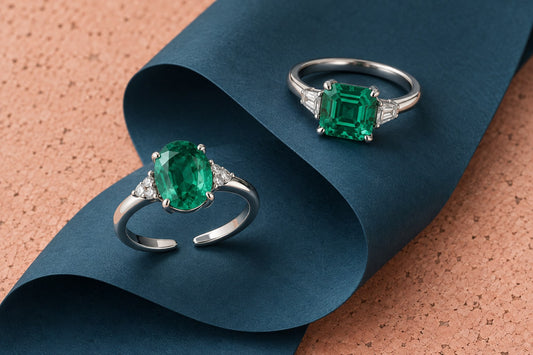
For a green center, read the lab-created emerald guide before choosing a ring by color alone. For a colorless stone, the moissanite and lab-created diamond comparison helps separate two different materials that are sometimes grouped together in shopping searches.
Keep disclosure precise. A ring advertised as diamond-like isn't necessarily diamond, and a gemstone's laboratory origin doesn't make all care instructions interchangeable. Ask what the center and accent stones are, whether treatments are disclosed, and what cleaning method is approved for the finished ring.
Plan the wedding band before the wedding

Try the engagement ring with the intended band whenever possible. Check the pair from above, from the side, and while bending your finger. Notice contact between the band and basket, not just whether the rings look close together. Continuous rubbing can be a maintenance concern.
A curved band can follow the center setting. A spacer can separate certain designs. Wearing the rings on different hands is another reasonable choice. None of these arrangements needs to be treated as a compromise if it suits your preferences.
If you are buying the engagement ring as a surprise, collect information about the recipient's existing jewelry without guessing their size from a photograph. A discussion about general style, metal color, and lifestyle can preserve the surprise of the proposal while making the ring choice much more informed.
Questions to resolve before checkout
Ask for the stone measurements, setting height, metal specification, available sizes, resizing limitations, and maintenance guidance. Confirm whether the images show the exact design and whether different stone sizes change its proportions. Keep written answers with the order information.
Read the current return and custom-order terms rather than assuming an engagement ring follows the same rules as every other item. Don't build a proposal date around an unconfirmed delivery estimate. If timing is tight, resolve availability and shipping before choosing any optional customization.
Once the ring arrives, inspect it in good light before regular wear. Check that the center appears secure, the finish matches the description, and the ring feels comfortable through ordinary hand movement. Don't deliberately stress the setting to prove its strength. For silver designs, the cleaning and storage guide offers a conservative starting point.
Frequently asked questions
Is a low-profile ring always best for everyday wear?
No. A lower profile can reduce projection, but comfort, construction, stone protection, and wedding-band fit also matter. Judge the complete design against your routine.
Will a high setting make a stone sparkle more?
Height alone does not determine sparkle. The gemstone's optical properties, cut, cleanliness, lighting, and setting design all affect its appearance.
Are six prongs always safer than four?
No. Prong count is only one detail. Correct placement, workmanship, metal condition, stone shape, and regular inspection are also important.
Can any straight wedding band sit flush with an engagement ring?
No. A low basket or projecting setting can prevent a straight band from sitting flush. Check the rings together before choosing a band, or consider a curved design or a deliberate gap.
A ring that belongs in your everyday life
Choose the setting with your hand in motion, not only with the ring facing a camera. Clear side views, a comfortable fit, appropriate stone protection, and a realistic care routine are more useful than a fashionable style label. The right design should feel considered every time you put it on.
Editorial responsibility: Lumingem Editorial Team. Product-specific questions: shopify@lumingem.com.
Tags:
Previous
A Guide to Lab-Created Emerald Jewelry: Color, Care, and Styling
Next
How to Clean and Store 925 Sterling Silver Jewelry
Related articles
How to Pack Hip-Hop Jewelry for a Weekend Away
Sep 14 2026