
A Guide to Lab-Created Emerald Jewelry: Color, Care, and Styling
Lab-created emerald jewelry is a way to wear emerald's distinctive green without choosing a mined stone. The useful buying questions are less romantic but more revealing: What is the gemstone actually made of? How large does it look? Is the setting comfortable? And what care does the finished piece require?
GIA’s emerald reference distinguishes synthetic counterparts from imitations; its care guidance explains heat and ultrasonic-cleaning risks.
Start with the lab-grown emerald jewelry collection, then compare individual specifications rather than treating every green design as interchangeable. A pendant, a pair of studs, and a bracelet can use a similar color yet ask very different things of the wearer. This guide focuses on choosing a first piece and reading its description accurately.
The short version

- Lab-created describes origin, not a different green color or a universal quality grade.
- Confirm the material, dimensions, metal, and any treatment information before comparing prices.
- Choose the jewelry category around how you dress and move, not just the largest stone you can afford.
- Use conservative care when the treatment or setting construction is unknown.
What lab-created emerald means
Emerald is the green variety of beryl. A laboratory-grown emerald has essentially the same chemical composition and crystal structure as its natural counterpart, but it grows under controlled conditions rather than in the earth. A green glass stone, green cubic zirconia, or green-colored sapphire is a different material, even when a photograph looks similar.
That distinction matters when reading a listing. “Emerald cut” describes a shape and faceting style; it does not identify the gemstone. A colorless stone can have an emerald cut, while emerald material can be fashioned into a round, oval, pear, or other shape. Look for a specific gemstone statement instead of inferring identity from the title's color or cut language.
“Created” also doesn't mean indestructible, inclusion-free, or automatically untreated. Ask for the information available for the particular piece. A general explanation of laboratory growth cannot substitute for a product description, and a seller's use of the word “premium” doesn't tell you the stone's measurements or treatment history.
Separate origin from broader promises
Laboratory origin alone does not establish a finished jewel's environmental impact, labor standards, or resale value. Those claims need separate evidence about production and supply chains. You can prefer a lab-created stone for its appearance or price without attaching a sustainability promise that the seller hasn't documented.
Read color in context, not from one photograph
Color is usually the first thing you notice, but a screen is an imperfect shopping tool. Lighting, camera processing, the background, and your display can change the apparent green. Compare several views of the same piece, preferably including an ordinary-light image and a view that shows the jewelry's scale.
Describe what you like in plain language. Do you want a lively, bright green, a cooler blue-green impression, or a deeper green that feels quieter with dark clothes? Those preferences are more helpful than deciding every emerald must match one ideal photograph. A very dark appearance in a particular image also warrants another view before you assume the stone will look equally dark in person.
Look at how the center responds as its angle changes. A short video can help you distinguish facets that brighten and darken during movement from a broad area that stays visually flat. Video is still not a laboratory assessment. Its value is practical: it offers another view of a piece you cannot hold.
Match the viewing task to the jewelry
A pendant is seen against clothing and skin, often from a few feet away. Earrings frame the face, where a small color accent can be enough. A bracelet moves through changing light as your wrist turns. Don't reject a modestly sized stone just because an enlarged product photograph makes it seem less dramatic than another listing.
Compare dimensions before carat weight

Carat is a measure of weight, not a promise of visible size. Two stones with similar weights can have different outlines and depths. Millimeter dimensions tell you more about how much of your neckline, earlobe, or wrist a design will occupy. Check whether a measurement refers to the center stone or the entire setting.
A simple paper outline can help. Draw the listed overall dimensions at actual size and hold the outline near the intended location. It won't reproduce brilliance or depth, but it can reveal that a pendant is much larger than you expected. For earrings, consider both the front dimensions and how far the setting projects from the ear.
Also distinguish a center-stone weight from total gemstone weight. The latter can combine many stones, including small accents. A large total is not evidence of a large emerald center. If the listing combines several gem types, the breakdown should be clear enough that you know what you're comparing.
Choose the format around your routine
A necklace for a single color focal point
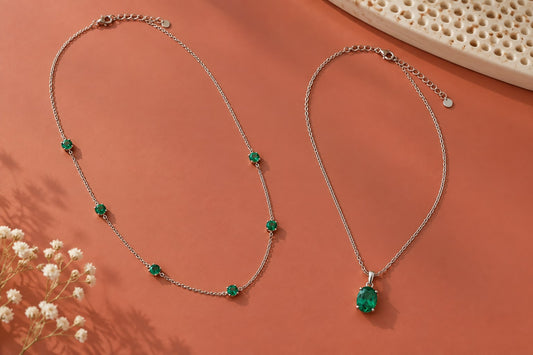
A pendant is a useful starting place if you want green in your wardrobe without thinking about matching a pair or sizing a ring. Compare chain length, whether the chain is included, and the size of the pendant bail. An attractive center can feel awkward if it sits directly on the edge of your usual neckline.
Use your own comfortable necklace as a reference. Measure it laid flat rather than relying only on the way a model wears a piece. Neck size and body proportions change where the same chain length falls. The necklace selection is a starting point for comparing overall proportions; verify the exact material on each listing.
Earrings for controlled, repeatable color
Studs offer a compact accent, while longer earrings add movement and more visual coverage. For a pair, look for a balanced impression rather than expecting every small internal detail to be identical. Check the fastening type, post information if supplied, and whether the design suits the recipient's existing piercings.
Our emerald earring buying guide covers the category in more detail. Keep comfort separate from the photograph: larger fronts and decorative settings can feel different during a full day than during a brief fitting.
A bracelet for movement and a broader green line
A gemstone bracelet introduces several additional checks: usable length, articulation between settings, clasp operation, and any safety fastening. Repeated stones create a different effect from one center gem. Compare the bracelet designs with that in mind instead of judging them by the largest stone alone.
A close fit can reduce movement but shouldn't pinch. A loose bracelet can slide into the hand or strike a desk. Measure a bracelet you already wear comfortably, and ask how the listed length is measured if the clasp design makes the answer unclear.
Understand what the setting contributes
Metal influences both the appearance and the maintenance of the finished jewel. A white metal can create a crisp contrast with green; a warmer metal changes the overall palette. Those are style choices, not gemstone grades. Check the base metal separately from any surface plating.
For sterling silver jewelry, a 925 description identifies an alloy containing 92.5 percent silver. It does not tell you every other component, the plating thickness, or whether the piece will suit a particular sensitivity. If you react to specific metals, request detailed information rather than relying on “hypoallergenic” as a blanket assurance.
Prongs, bezels, and decorative borders also change the impression of size. More metal around a stone can make the piece look more substantial. Less visible metal can give a lighter appearance. Neither guarantees security; that depends on construction, condition, and maintenance. Any loose stone or catching prong deserves professional attention.
Price the complete piece

A meaningful comparison includes the gemstone's identity, visible size, metal, construction, chain or fastening, and the services actually included. Comparing a pendant without a chain against a complete necklace will distort the value judgment. So will comparing one large center stone against many small stones using only total weight.
Make a short comparison sheet with the details you can verify. Leave missing information marked as missing instead of filling it in from a photograph. If one seller supplies clear dimensions and another doesn't, the next step is a question, not an assumption that the cheaper piece is equivalent.
Review the current shipping and return terms before ordering, particularly for gifts or custom work. This guide is not a substitute for the terms shown with your purchase. Save the product description and any written answers that materially influenced your choice.
Care without taking unnecessary risks
Emerald jewelry should not be treated like an all-purpose cleaning experiment. When treatment details are unknown, avoid ultrasonic cleaners, steam, chemical dips, and prolonged soaking. Start with a soft, clean cloth. Follow the seller's instructions for the entire piece, not just the base metal.
Take jewelry off before swimming, household cleaning, or activities that can knock it against hard surfaces. Store pieces separately so settings and chains don't rub together. If a gem becomes loose or the metal catches on clothing, stop wearing it until a qualified jeweler checks it. The silver cleaning and storage guide explains why mixed-material pieces need extra care.
Frequently asked questions
Is lab-created emerald the same as green cubic zirconia?
No. Lab-created emerald is emerald material grown in a laboratory. Green cubic zirconia is a different material that can imitate a similar color. Read the gemstone description rather than relying on appearance.
Does an emerald cut mean the stone is emerald?
No. Emerald cut describes the shape and faceting style. The gemstone can be emerald, diamond, or another material, so the material must be identified separately.
Is a necklace easier to size than an emerald ring?
A necklace avoids finger sizing, but chain length and pendant dimensions still affect fit. Compare them with a necklace the wearer already finds comfortable.
Can I use an ultrasonic cleaner on lab-created emerald jewelry?
Do not use one without specific approval for the stone, any treatments, and the setting. When those details are unknown, use conservative care and ask the seller or a qualified jeweler.
Choose the piece you can picture wearing
The best first emerald purchase starts with clear material disclosure and ends with a design that fits your life. Compare color in several views, check actual dimensions, and read the details of the complete setting. A modest piece that feels right with your clothes and routine can be a more satisfying choice than a larger one bought on weight alone.
Editorial responsibility: Lumingem Editorial Team. Product-specific questions: shopify@lumingem.com.
Tags:
Previous
How to Style a Tennis Bracelet: Everyday to Evening
Next
How to Choose an Engagement Ring Setting for Everyday Wear
Related articles
How to Pack Hip-Hop Jewelry for a Weekend Away
Sep 14 2026