
How to Choose Paraiba-Colored Lab-Grown Gemstone Jewelry
“Paraiba” can refer to a specific copper-bearing tourmaline context, but it is also used descriptively for vivid blue-green color in contemporary jewelry. A careful buyer separates color language from material identity before comparing design.
The mineral distinction is explained in GIA’s tourmaline reference, including Paraiba’s association with copper coloration.
Begin With Accurate Naming
Natural Paraiba tourmaline is a specific gemological category associated with copper-bearing tourmaline. A Paraiba-colored lab-grown gemstone may evoke that neon palette without being natural Paraiba tourmaline.
The product description should identify the material beyond its color nickname. Read each item independently, because a shared blue-green appearance does not establish a shared gemstone species.
Read each item individually and ask when terminology is unclear.
Choose Your Blue-Green Direction
Some buyers prefer electric blue, others balanced turquoise or a greener lagoon tone. Compare the dominant face-up hue rather than searching for one universal digital swatch.
Color should remain attractive in neutral daylight and ordinary indoor light. A dramatic glow effect in photography is not a substitute for useful color information.
View several images with consistent screen settings and note whether saturation overwhelms transparency or facet detail.

Evaluate Tone and Saturation
Medium-light tone often helps blue-green color feel luminous, while darker tone can create depth. Very pale stones may need greater size or stronger saturation for visual presence.
Select based on the finished jewel and intended distance: a bracelet station is seen differently from a pendant near the face.
Avoid equating maximum saturation with automatic quality; balance and personal preference matter.
Compare Cuts for the Design
Emerald cuts organize color into broad steps and a sleek outline. Ovals offer lively brilliance, while round stations repeat rhythmically in bracelets.
Cut quality should support the chosen style with symmetry, even polish and no distracting dead center.
Inspect vulnerable corners, girdle protection and how the setting follows the outline.
Inspect Setting and Chain Construction
Prongs can create an open, bright presentation. Bezel-style station settings protect more of the edge and keep bracelets smooth. Bails and jump rings should be proportionate to chain thickness.
A piece is only as wearable as its smallest connection.
Check prongs, bezels, links, clasp action, extension chain and whether the gemstone sits level.

Choose Necklace or Bracelet by Routine
A pendant remains visible near the face and is easy to coordinate with necklines. A bracelet provides repeated movement and color but contacts desks, sleeves and surfaces more often.
Consider work habits, dominant hand, layering preferences and tolerance for movement.
Use product measurements and clasp details rather than judging scale from enlarged images.
Verify Seller Information
A useful listing identifies material, metal, dimensions, care, shipping and returns. It should not rely on rarity language that blurs natural and lab-grown categories.
Save the description at purchase and keep order documentation.
Review each candidate separately and ask for clarification when the gemstone identity is not fully stated.

Make the Decision in the Right Order
First confirm identity and construction; next evaluate color and cut; finally decide whether the style fits real life. This order prevents a striking photograph from overriding basic facts.
Compare two or three finalists using the same checklist.
Choose the piece whose disclosed material, blue-green character and practical design all make sense together.
A color name should never do the work of a material description
Read the product title and the specification table as two separate sources of information. A title may emphasize a familiar color phrase to describe the look. The material field should explain what the stone actually is. If the second part remains unclear, the first part cannot fill the gap.
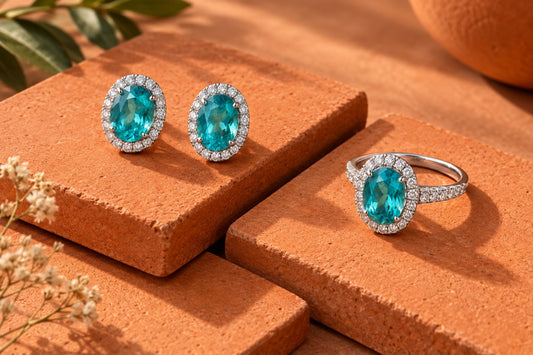
For example, the Paraiba-color YAG multirow ring specifically describes its main stone as lab-created YAG, or yttrium aluminum garnet. That is more specific than a blue-green color label. It should not be retold as natural Paraiba tourmaline, even if a photograph evokes a similar palette.
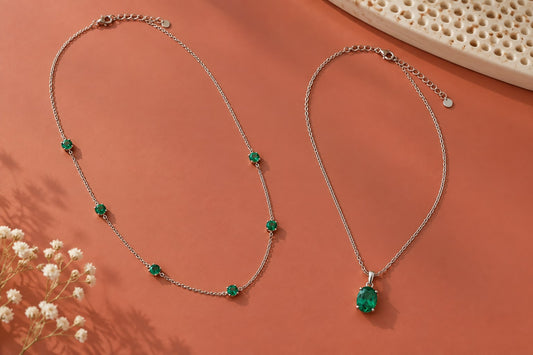
A different item can carry broader wording. The pear-cut Paraiba-color necklace uses a color-based gemstone description. Read its current disclosure and ask for any further identity information you need. Don't transfer the YAG description from the ring to the necklace simply because both appear blue-green.
Ask a question the seller can answer precisely
“Is this real?” is understandable but ambiguous. It can mean natural, correctly identified, not glass, as photographed, or worth the price. A specific question gets a more useful answer: “What is the mineral or manufactured material of the center stone in this exact variant, and is it natural or laboratory-created?”
Then ask about the accent stones separately. A halo can contain cubic zirconia, moissanite, or another disclosed material; its arrangement doesn't identify its composition. The same caution applies to descriptions such as crystal, simulated, created, and gemstone. Read them in context rather than assuming they are synonyms.
If documentation is shown, establish whether it belongs to the individual item or is a sample. The gemstone document guide explains how to match a report to a purchase and why a decorative card is not the same as an independent examination.
Compare the complete dimensions, not a magnified center
A stone's millimeter measurements help you picture its outline. The finished jewelry measurements tell you how much space the setting occupies around it. Keep both where available. A decorative halo can change the visual footprint without changing the center stone's size.
For earrings, confirm whether a weight figure applies to each stone or the pair. For a multi-stone bracelet, find out whether it describes the total or a single element. For a necklace, separate pendant dimensions from chain length. These distinctions prevent a large number in a title from taking over the comparison.
If a listing mixes units or leaves the scope unclear, pause and ask. A careful answer before purchase is more useful than discovering after delivery that two apparently similar numbers measured different things.
Use photographs to ask questions, not certify properties
A photograph can help you assess the outline, visible color, and arrangement. It cannot prove the gemstone species, treatment status, or long-term durability. Keep those claims tied to explicit disclosure and appropriate evidence.
Review the side and back as well as the hero image. In a ring, the height of the setting affects its profile. In a pendant, the back and attachment affect how it sits. In earrings, the post and closure are part of the product even if the front is the reason you noticed it.
Ask for a second lighting condition when color is central to the decision. The Paraiba-inspired color guide can help describe blue-leaning versus green-leaning preferences. No single digital swatch guarantees the appearance of a physical stone on every screen.
Reject comparisons that depend on an unproven equivalence
A low price compared with a rare natural gemstone doesn't establish exceptional value if the products are different materials. Compare the item with other pieces whose disclosures you understand. Design, setting, metal, and included components belong in that comparison too.
Don't assume that a laboratory-created label automatically proves environmental or labor claims. Those are separate claims requiring their own support. You can choose a piece for its appearance and disclosed material without adding a sustainability story that the seller hasn't documented.
Similarly, avoid treating a future resale price as part of the purchase unless you have specific, reliable evidence. For a fashion or personal jewelry purchase, the more practical question is whether the item suits your intended wear at a price you're comfortable paying.
Finish with the care and service questions
Care should match the whole piece, including the finish, setting, and any disclosed treatment. If the material is uncertain, don't assume a cleaning method from a different blue-green gemstone applies. Ask before using steam, ultrasonic equipment, or chemical dips.
Check what to do if a clasp feels wrong or a stone appears loose on arrival. Keep packaging and order details, and contact the seller rather than bending or repairing the piece yourself. Read current terms for the selected item and destination, particularly for custom work.
Once those questions are settled, choose the format that fits your life. The necklace versus bracelet guide compares placement and movement without assuming that all Paraiba-colored pieces share one material. Accurate naming makes that final styling decision easier, not less enjoyable.
Frequently Asked Questions
Is Paraiba-colored lab-grown jewelry natural Paraiba tourmaline?
Not necessarily. “Paraiba-colored” describes a visual direction. Read the exact gemstone identity on the individual listing.
Why do Lumingem Paraiba-colored products use different material descriptions?
Descriptions differ between items. Read the selected product page and request clarification or supporting documentation when its gemstone identity is unclear.
Which cut shows blue-green color best?
There is no single winner. Emerald cuts create broad color planes; ovals and rounds can produce more scintillation.
Is a necklace easier to wear than a bracelet?
Often, because it receives less surface contact, but comfort, chain length and wardrobe determine the better choice.
What should I check before buying?
Verify exact gemstone identity, metal, size, setting, clasp, care, shipping and return terms.
Compare Paraiba-Colored Listings Line by Line
Place the material-description sentence from each candidate in a separate row. Keep a specific YAG disclosure separate from a broader Paraiba-color description. Add the metal, finish, dimensions, setting, and care information beneath each entry before comparing the photographs again.
This order exposes whether two pieces are truly comparable or simply share an aqua color family. It also makes seller questions precise: ask about the exact item, not “Paraiba jewelry” in general. A buyer can love the same blue-green visual effect across different disclosed materials, but the choice should be conscious and the product should never be represented later as something the listing did not claim.
Conclusion
A good Paraiba-color purchase starts with a clear material description, not a color nickname. Settle identity, dimensions, and construction first. Then compare the blue-green appearance and the design you want to wear. Keep unresolved claims as questions, and choose only when the answers are specific enough to support your decision.
Explore Lumingem for current lab-grown gemstone jewelry and return to the exact item page for authoritative specifications, availability, shipping and care details.
Editorial responsibility: Lumingem Editorial Team. Product-specific questions: shopify@lumingem.com.
Tags:
Previous
How to Care for Lab-Grown Padparadscha Sapphire Jewelry
Next
Paraiba Color Guide: Neon Blue, Green and Turquoise Explained
Related articles
How to Pack Hip-Hop Jewelry for a Weekend Away
Sep 14 2026