
Paraiba Necklace vs Bracelet: Which Style Should You Choose?
The same electric blue-green color behaves differently at the neckline and wrist. A pendant creates one controlled focal point; a bracelet turns the color into rhythm and movement. The better choice depends on the wearer’s habits, not a universal rule.
The mineral distinction is explained in GIA’s tourmaline reference, including Paraiba’s association with copper coloration.
Visibility and Point of View
A necklace is visible to other people and in mirrors, while a bracelet stays within the wearer’s own field of view. That difference can change emotional value.
Choose a pendant for face-framing color or a bracelet for frequent personal glimpses.
Consider sleeve length and neckline before comparing gemstone size.
Pendant Scale and Chain Length
An emerald-cut pendant feels graphic and modern; an oval pendant feels softer. Chain length determines where color meets the neckline.
A pendant should sit without rolling into a collar or disappearing beneath fabric.
Verify pendant dimensions, chain length, extension and bail clearance on the product page.

Bracelet Rhythm and Fit
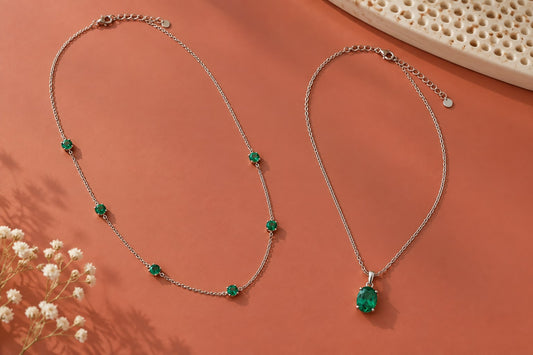
Station bracelets repeat small blue-green accents around the wrist. Fit should permit movement without sliding over the hand or catching constantly.
Too much slack increases impact; too little reduces comfort.
Check wearable length, extension chain, station spacing and clasp style.
Construction Differences
Necklaces depend on bail, jump rings and chain. Bracelets add repeated joins and receive more flexing. Secure bezels or prongs and clean solder work matter in both.
Inspect the whole piece, not only the gemstone.
Look for level stations, smooth backs, proportional links and decisive clasp action.
Daily Wear and Exposure
A pendant usually avoids desks and handwashing, although it can catch on hair or layers. A bracelet encounters sleeves, keyboards and surfaces.
People who use their hands intensively may find a necklace easier.
Remove either piece for exercise, swimming, showering and rough tasks.

Styling the Blue-Green Color
A pendant works as a single accent with open collars, crew necks and evening dresses. A bracelet can animate rolled sleeves and layer beside a plain silver chain.
Avoid crowding vivid color with several equally strong focal points.
Use cream, navy, charcoal, denim or warm neutrals as practical starting palettes.
Choosing a Gift
Necklaces avoid wrist sizing but require a comfortable chain preference. Bracelets feel personal and visible to the recipient but need a closer fit.
Learn what the recipient already wears most often.
For surprise gifts, compare current dimensions and return options before ordering.

A Simple Decision Framework
Choose necklace if face-framing color, lower impact and easy sizing matter most. Choose bracelet if movement, repeated color and wearer visibility matter most.
Then compare the exact material descriptions of the two candidates. Sharing a blue-green color family does not make them the same gemstone.
Make the final decision from the live listing, not from general category assumptions.
Compare the same outfit in two ways
Choose one outfit you wear often and imagine only a single change. In the first version, the color sits at your neckline. In the second, it sits at your wrist. This is a more useful comparison than looking at a formal necklace photograph beside a casual bracelet photograph, because the styling around the jewelry isn't making the decision for you.
A high collar can hide a short pendant, while long sleeves can hide a bracelet. Neither piece has failed; it simply doesn't have a visible place in that outfit. Consider whether you're willing to change the chain length, roll a sleeve, or choose another garment. If the jewelry requires constant accommodation, it may not be your everyday choice.
Repeat the exercise with an evening outfit and a weekend outfit. You don't need one piece to win in every situation. You need to know which situations matter most.
The necklace details that a front photograph misses
Look at the attachment between pendant and chain. A moving pendant and a fixed necklace design behave differently. Ask whether the chain can be removed and whether a different chain would fit if you intend to substitute one. Don't assume that every small opening will accept your existing clasp.
The emerald-cut Paraiba green pendant necklace is a product reference for a structured outline. Its individual listing, rather than the category name, should supply the material and construction details. If the gemstone species is not fully clear to you, ask before treating it as equivalent to another blue-green item.
A heavier-looking pendant also deserves a side view. You want to understand its depth and the shape of the back, not just the decorated front. A pendant that looks compact in a close-up may sit differently once its complete setting is taken into account.
The bracelet details that matter during movement
A bracelet must be judged as a flexible object, not just a row of attractive stones. Look at the connections between elements and the underside that rests against the wrist. Ask how the clasp closes and whether an extension is included if the length description is ambiguous.
The Paraiba green geometric bracelet uses a different layout from a continuous tennis bracelet. Compare its complete design and current specifications rather than assuming every colored bracelet creates the same movement or fit.
Measure a comfortable bracelet you already own using the seller's stated method where possible. Wrist circumference and finished bracelet length are not interchangeable. If the seller doesn't explain how fit is measured, ask rather than adding an arbitrary amount and hoping it works.
Also consider how you put it on. Some wearers are comfortable closing a small clasp one-handed; others prefer help or a different format. The necklace's clasp can be awkward too, so compare your actual experience rather than assuming wrist jewelry is always harder.
Layering changes the comparison
A necklace may share space with another chain, while a bracelet may sit beside a watch or a stack. Both arrangements create opportunities for contact. Start with the colored piece alone so you understand how it sits before adding more jewelry.
For necklaces, different lengths can separate the visual focal points, but they don't guarantee that chains won't tangle. Check the arrangement as you move and remove the pieces if they catch. For bracelets, avoid forcing rigid edges or raised settings against one another merely to complete a stack.
A color match isn't required. You can pair blue-green with plain metal and let texture do the rest. If every piece has a strong color and outline, decide whether that busy effect is intentional. Styling is a preference, not a rule that demands a matching set.
What to prioritize when the budget covers only one
Spend on the format you can picture wearing repeatedly in suitable settings. Don't divide the decision into “more stones” versus “fewer stones” without considering their identities, sizes, settings, and the construction. A necklace and bracelet with similar photographs can still be materially different products.
Record the disclosed gemstone, metal, finish, measurements, and included components for each candidate. Put a question mark beside missing information. The Paraiba-color buying checklist explains why the color label alone isn't enough for a like-for-like comparison.
If one option is clearly described and the other isn't, request clarification before comparing value. An unanswered material question matters more than a small difference in presentation.
Make a final choice with a use-first scorecard
You don't need numerical scores. Give each candidate a simple “works,” “needs checking,” or “doesn't suit me” against your usual clothes, fastening preferences, fit information, and care routine. A single unresolved fit issue can matter more than several attractive styling possibilities.
For a gift, use the recipient's habits rather than your own. The Paraiba-colored gift guide focuses on that situation. When the choice is for you, be equally honest: if you rarely wear bracelets, a striking photograph probably won't change that habit by itself.
Recheck the chosen listing before checkout for current options and delivery terms. Save the order details, inspect the piece when it arrives, and follow its care instructions. The decision isn't finished at the prettiest photograph; it's finished when the design, information, and intended use agree.
Frequently Asked Questions
Is a Paraiba-colored necklace more practical than a bracelet?
Often it receives less impact, but chain tangling, hair and neckline preferences still matter.
How should a station bracelet fit?
It should move comfortably without sliding over the hand or striking surfaces excessively. Use listed measurements.
Which is easier to gift?
A necklace is usually less size-sensitive; a bracelet can feel more personal if you know the recipient’s wrist fit.
Can I layer Paraiba-colored jewelry?
Yes. Keep spacing clear and let one blue-green piece remain the main focal point.
Are all linked Paraiba-colored products the same gemstone?
No. Read each product’s exact material description individually.
Run a Neckline and Wrist Trial at Home
Compare the listed pendant dimensions with a paper outline held beside a necklace you already own. For a bracelet, compare its stated length with a comfortable bracelet measured the same way. These simple references can clarify proportion without modifying or attaching anything to your jewelry.
During the trial, sit at a desk, put on a jacket and reach into a bag. Notice where a pendant disappears beneath fabric and where a bracelet contacts hard surfaces. The result may reverse an initial preference: someone drawn to bracelet movement may value a pendant’s lower exposure, while a wearer who dislikes adjusting necklaces may welcome a correctly fitted bracelet.
Conclusion
Choose a necklace when the color belongs with your necklines and you prefer to keep jewelry away from wrist contact. Choose a bracelet when you enjoy seeing movement and color on your wrist and have checked the fit. Neither format wins in every wardrobe; the useful choice is the one that works in yours.
Explore Lumingem for current lab-grown gemstone jewelry and return to the exact item page for authoritative specifications, availability, shipping and care details.
Editorial responsibility: Lumingem Editorial Team. Product-specific questions: shopify@lumingem.com.
Tags:
Previous
Paraiba Color Guide: Neon Blue, Green and Turquoise Explained
Next
How to Care for Paraiba-Colored Lab-Grown Gemstone Jewelry
Related articles
How to Pack Hip-Hop Jewelry for a Weekend Away
Sep 14 2026