
Lab Grown Emerald, Lab Created Emerald and Synthetic Emerald: Reading the Labels
You open three jewelry listings and see three different phrases: lab grown emerald, lab created emerald and synthetic emerald. Before comparing prices, you want to know whether the wording describes the stone's origin, its appearance or the finished jewelry. That is exactly the right place to start.
These terms are commonly used for emerald produced in a laboratory rather than formed naturally in the earth. However, a short title is not a complete specification. Read the detailed description and ask for clarification whenever the wording leaves the actual stone identity uncertain.

Read the origin statement separately
Start by finding the sentence that identifies the stone and states its origin. Do not infer origin from the color, a very clear photograph or the price. A natural emerald and a laboratory-created emerald need clear descriptions; the word green does not identify either one.
Similarly, an imitation that resembles emerald should not be confused with laboratory-created emerald simply because both can be used in green jewelry. If the listing uses terms such as emerald color, simulated and synthetic without explaining them, ask the seller which material is actually supplied.
Use the title as a starting point
A title such as lab created emerald ring gives you a useful direction, but it does not tell you the metal, stone dimensions, treatment information or setting construction. Find those details in the body of the listing. When the title and description disagree, resolve the discrepancy before buying.
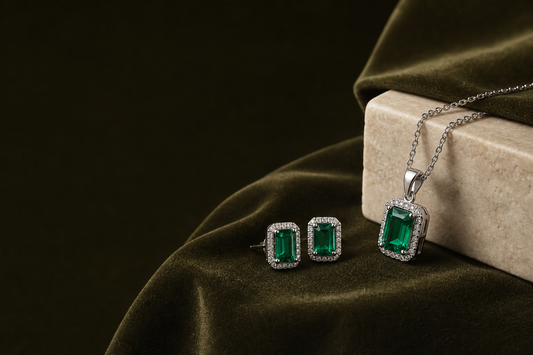
Ask which stones the description covers if the design has a colored center and clear accents. A center stone identified as lab grown emerald does not automatically identify the surrounding stones. Each component should have enough information for you to understand what you are comparing.

Separate origin from visual preference
Origin tells one part of the story. You still need to decide whether you like the particular stone's color and cut. Compare the overall shape, stated dimensions and photographs under more than one lighting condition when available. A larger center stone is not automatically a better choice for your wardrobe.
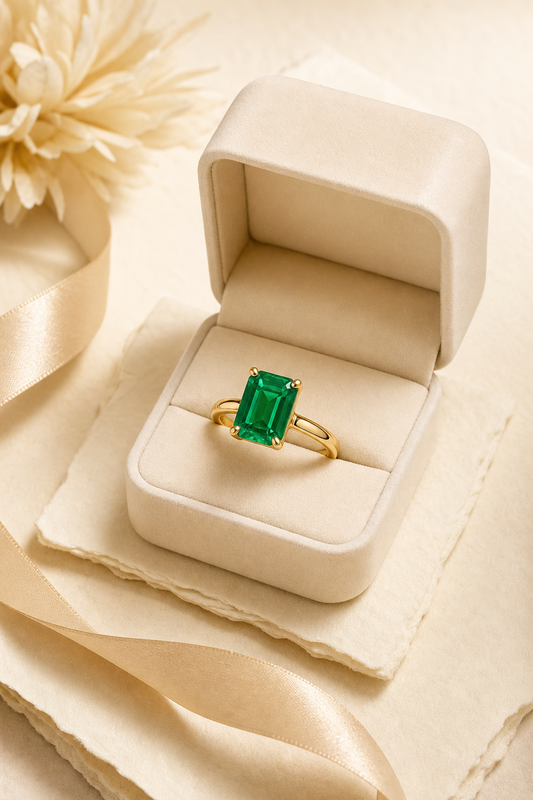
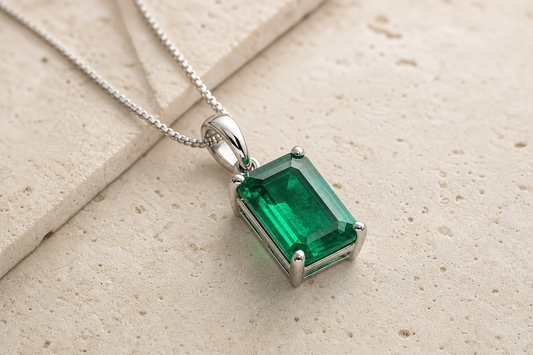
For a ring, consider how the stone's outline relates to your hand and the setting. For earrings, compare the pair as a whole. For a pendant, think about the color against the clothes you actually wear. These are questions of personal preference, not conclusions you can draw from an origin label alone.
Read the finished jewelry specifications
Emerald jewelry includes much more than the gemstone. Check the metal, any surface finish, the fastening and whether a chain is included with a pendant. For rings, look for the available sizes and the height of the setting when provided. For earrings, confirm whether the price is for one or a pair.
Do not assume all lab grown emerald jewelry shares the same construction. Two pieces with similar-looking stones can have different proportions, metal descriptions and practical features. Compare like with like instead of treating the shared gemstone name as proof that the finished pieces are equivalent.
Ask useful questions about documentation
If a report or certificate is mentioned, ask what it identifies and whether it refers to the stone or item you will receive. Check that the description of the document matches the actual information supplied. A report, a shop appraisal and a general product card do not necessarily answer the same questions.
Avoid using a single photograph as an authenticity test. When you need independent confirmation of material identity, seek an appropriately qualified gemological professional rather than relying on color or online visual shortcuts.

Make a short comparison record
Write down the stated stone identity, origin, dimensions, metal, finish and any disclosed treatments for each piece you are considering. Mark missing details as questions rather than filling them in yourself. This makes it easier to spot a genuine difference between products and a difference that exists only in marketing language.
When exploring jewelry at Lumingem, read each product's individual specifications. Whether your search began with synthetic emerald jewelry or lab created emerald, a clear decision comes from the complete description, a design you enjoy and practical details that suit the way you will wear it.
Tags:
Previous
Lab Grown Emerald Rings: Low-Profile or Statement Settings?
Next
Padparadscha and Blue Sapphire Jewelry: Two Ways to Add Color