
Emerald Jewelry Value FAQ: Comparing Price, Size and Construction
Is this emerald jewelry worth the price? Before that question can be answered, another one often needs attention: what material is actually being offered? Real buyer discussions about natural emerald, synthetic emerald and green imitations show why similar-looking pieces should not automatically be compared as equivalent purchases.
This FAQ turns those concerns into a practical comparison process. It is not a price appraisal or a promise about resale. The aim is to help you identify missing information, decide what matters to you and compare complete pieces rather than isolated photographs.

Q: Can a low price tell me whether an emerald is genuine?
No price is an identification test. Ask for the stone's specific identity, whether it is natural or laboratory-grown and any relevant treatment disclosure. An unusually low or high price can prompt questions, but it cannot supply the missing material information.
Likewise, a green color or an impressive product title does not establish that two stones are the same material. GIA distinguishes laboratory-created emerald from imitations and explains why appropriate examination matters. Resolve that distinction before treating a price difference as a bargain.
Q: Is laboratory-grown emerald jewelry always the better value?
Value depends on your priorities and the actual products. If your goal is a particular appearance within a budget, compare clear descriptions and finished dimensions. If natural origin is essential to you, that is a separate preference that should be supported by the information supplied.
Do not assume laboratory origin guarantees excellent cutting, a strong setting or a suitable metal. Those are individual construction and quality questions. A material category should not be used as a shortcut around evaluating the piece itself.
Q: Why can two similar-looking pieces have different prices?
Differences may involve stone identity and origin, treatment information, dimensions, appearance, metal, setting and documentation. One listing may also include components that another sells separately. Photographs alone rarely make all of those differences visible.
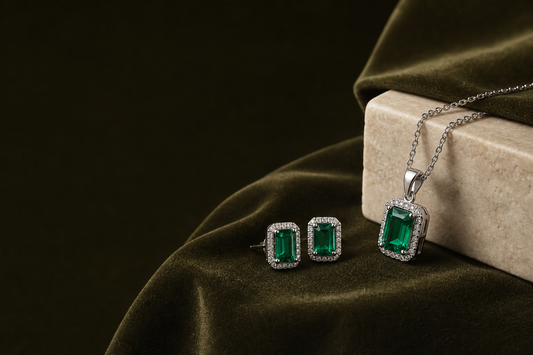
Compare the same kind of purchase. Check whether a pendant includes a chain, whether earrings are sold as a pair and whether the selected size changes the specification. A starting price beside a product image may not be the price of the option you intend to order.

Q: Does a larger carat number mean a visibly larger piece?
Carat measures gemstone weight, not the complete jewelry dimensions. Ask for face-up stone measurements and the finished item's measurements. A surrounding border or a substantial setting can change the visible outline without making the center stone larger.
If a listing gives total stone weight, check what it includes. A total covering several stones is not directly comparable with one center stone's weight. Compare with a piece you already own so the measurements have a practical reference beyond a close-up photograph.
Q: What should I examine besides the center stone?
Check the stated base metal, finish, fastening and supplied components. Look for useful views of the back, sides and connection points. For rings, consider setting height and fit. For necklaces, consider the pendant bail and the chain information.
Do not infer solid construction, a particular metal purity or a coating thickness from color alone. If an important specification is missing, ask before deciding the higher or lower price represents better value. The answer should describe the actual item, not just the general collection.
Q: Does a certificate make the purchase worth its price?
Documentation is useful only when you understand its scope and connection to the item. Ask who issued it, what it identifies and whether the information relates to the stone being supplied. A generic card is not automatically equivalent to an independent gemological report.
Identification, quality description and monetary appraisal are different tasks. Do not assume one document performs all three. If you need an independent value assessment for a significant purchase, seek an appropriate professional appraisal rather than relying on a general buying guide.

Q: What is a sensible final comparison?
Put the material description, origin, treatment information, dimensions, metal, included components and documentation side by side. Then check current return conditions, sizing options and delivery information. Those practical details can affect whether the piece suits your purpose.
When browsing jewelry at Lumingem, use the individual product information and ask about any unresolved details. Choose what fits your preferences and budget without treating a discount percentage or a gemstone name as a complete measure of value.
The underlying identity concern appears in this buyer discussion about emerald and synthetic or imitation materials. Comparison context: GIA's emerald buyer's guide and laboratory-created emerald FAQ. The comparison prompts here are editorial guidance, not a ranking of frequently searched questions.
Tags:
Previous
Hip Hop Jewelry Wholesale FAQ: Samples, Minimums and Repeat Orders
Next
Lab Grown Emerald Ring FAQ: Daily Wear, Settings and Gentle Care