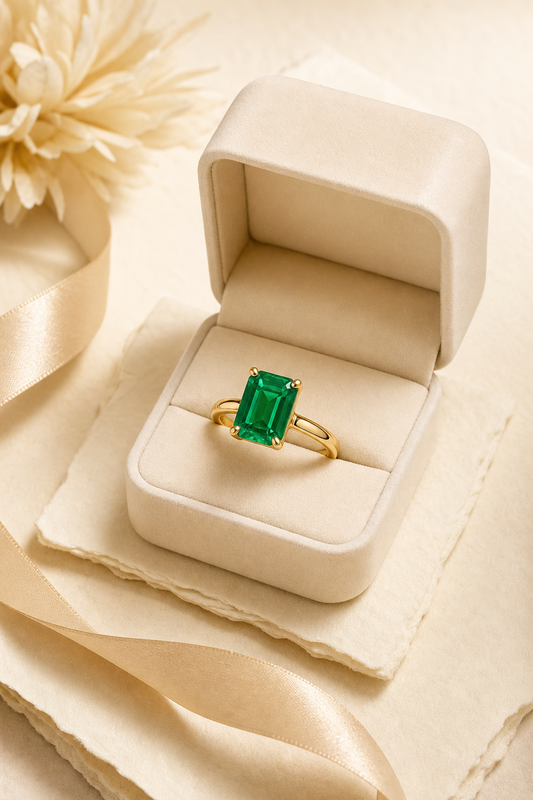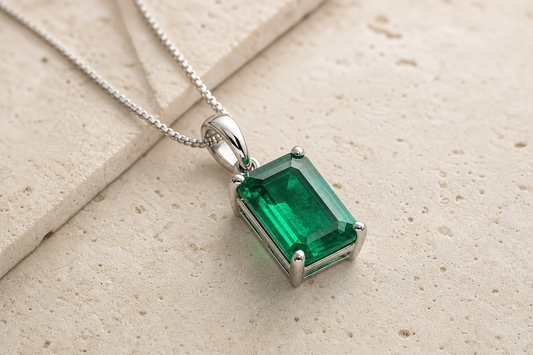

Lab Grown Emerald FAQ: Created, Synthetic or Imitation?
Is a synthetic emerald real emerald or just green glass? Can someone tell from a photograph? Buyer discussions show how quickly the words real, created and imitation become tangled. The useful starting point is to separate what the material is from where it formed.
This lab grown emerald FAQ addresses that confusion. An attractive green appearance can be a reason to like a piece, but it is not enough to identify the stone or establish its origin. Clear terminology makes comparing emerald jewelry much easier.

Q: Are lab grown and lab created emerald different things?
These descriptions generally indicate emerald grown through human-controlled processes rather than formed naturally. Read the complete listing because a title alone may be incomplete. The seller should make both the material identity and laboratory origin clear.
Do not assume a product has a particular growth method, treatment history or quality simply because it uses one of those phrases. Ask about the actual stone when those distinctions matter to you.
Q: Does synthetic mean fake or glass?
In gemology, synthetic does not mean any imitation. GIA describes laboratory-created materials as having essentially the same chemical composition, crystal structure and optical and physical properties as their natural counterparts. An imitation may resemble emerald without being emerald.
That distinction is why a lab created emerald and a green glass look-alike should not be described as interchangeable. A stone can have laboratory origin and still be emerald; a green appearance alone does not establish that identity.
Q: What does real emerald mean in a listing?
The word real is too ambiguous to carry the whole description. Ask whether the seller means natural emerald, laboratory-grown emerald or simply a green stone. Material identity and origin are separate facts, and both should be understandable before purchase.
If the title and detailed description disagree, resolve the inconsistency first. Do not fill in a missing specification with the meaning you hope the seller intended. Save the relevant product information if you need to refer to it later.

Q: Can inclusions prove that an emerald is natural?
Do not use visible inclusions alone as a home identification method. GIA's discussion of laboratory-created emerald explains that distinguishing it from natural material is a task for trained gemologists using appropriate examination.
Likewise, a very clean appearance does not prove a stone is glass or laboratory-grown. Social-media guesses may identify a reason to investigate, but they do not replace professional identification of the item itself.
Q: Can someone identify my stone from a phone photo?
A photo is useful for describing visible shape, mounting and apparent color. It cannot reliably establish material identity, origin or treatment. Lighting, reflections and image processing can obscure or imitate visual features that people try to interpret.
If identification affects an important purchase, ask what appropriate testing or documentation is available. Do not scratch the stone, expose it to heat or use household chemicals to experiment. Damage does not provide a reliable substitute for gemological examination.
Q: Does laboratory origin tell me everything about quality?
No. You still need dimensions, condition, cut appearance, setting details and accurate treatment information. Two laboratory-grown emerald pieces can differ substantially in their visible proportions and finished construction even when they share a material description.
Compare the whole item rather than treating origin as a complete quality grade. For a ring, check the profile and sizing information. For a pendant, check the bail, chain inclusion and finished measurements. For earrings, confirm whether the listing supplies one or a pair.

Q: What wording should I look for before buying?
Look for a specific stone name, natural or laboratory origin, any relevant treatment disclosure and the jewelry's metal and finish. Ask what a supplied report covers instead of assuming the word certified guarantees every feature of the finished piece.
When browsing jewelry at Lumingem, read each listing individually. Choose a design because you like its appearance and understand its specifications, not because an unclear word seems to promise more than the description states.
Real question source: a discussion about distinguishing emerald, synthetic material and imitations. For identification context, see GIA's laboratory-created emerald FAQ. Comments in the discussion are not identification findings.
Tags:
Previous
Lab Grown Emerald Ring FAQ: Daily Wear, Settings and Gentle Care
Next
Padparadscha FAQ: Color Names, Treatments and Buying Confidence