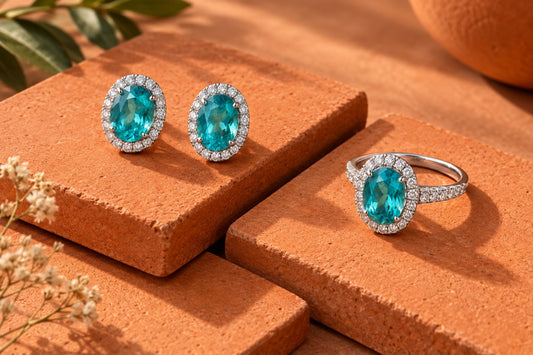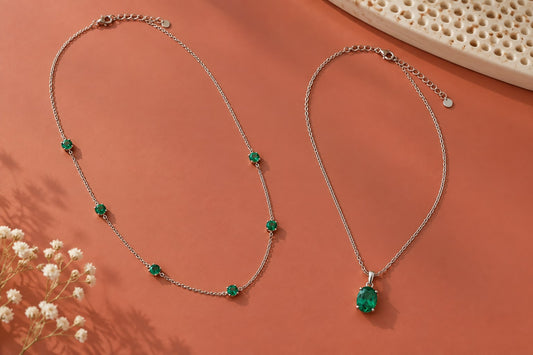

Moissanite vs. Diamond: Sparkle, Hardness, and Key Differences
Moissanite and diamond can both look bright and beautiful, but they don't handle light in exactly the same way. Moissanite tends to show more rainbow-colored fire. Diamond has its own balance of white brightness, colored flashes, and contrast. Neither description tells you which one you'll prefer on your hand or around your neck.
GIA’s 1997 study, Synthetic Moissanite: A New Diamond Substitute, identifies silicon carbide and documents its optical properties and Mohs hardness of 9¼. These are material properties, not a quality grade or a guarantee for an individual jewel.
The useful comparison isn't a contest to find a universal winner. It's a way to choose the look you actually enjoy, in a size and setting that suit your routine. This guide focuses on appearance and wearing experience. If you need help decoding laboratory origin, reports, or product labels, our moissanite and lab-created diamond buying guide covers that separate decision.
Two different gems, not two grades of the same stone

Diamond is crystalline carbon. Moissanite is silicon carbide. Modern jewelry moissanite is laboratory created, but that doesn't make it a lab-grown diamond. A laboratory-grown diamond is diamond; moissanite is a different gemstone with different optical properties.
This matters even if you're shopping mainly by appearance. You shouldn't need to pretend one material is another to enjoy it. A moissanite ring can be chosen for its lively fire, while a diamond ring can be chosen because diamond is the material you want. Honest naming leaves room for both preferences.
Diamond in a comparison can mean natural or laboratory grown. The origin should be stated separately. Don't assume an unqualified photograph or comparison chart is showing one rather than the other, and don't use a moissanite price as a direct substitute for a diamond quote without reviewing the complete specifications.
What sparkle looks like outside a product video
Sparkle is an everyday word for several visual effects. Brightness refers to returned white light. Fire refers to flashes of spectral color. Scintillation describes the pattern of light and dark changes as the stone, light, or observer moves. A gemstone isn't producing the same display under every lamp.
Under direct lighting
Small, intense lights can bring out colored flashes. This is where moissanite's fire can be especially noticeable. If that lively rainbow effect is the reason you're shopping, look for a video that moves the stone slowly enough to see it rather than one edited into fast bursts of sparkle.
Don't let that single clip make the whole decision. Jewelry-store spotlights and a phone flashlight aren't the conditions most people live in all day. Strong direct light is useful for seeing one part of the stone's character, not for predicting every moment of wear.
In soft daylight
Indirect window light is helpful for judging the stone's overall face-up appearance and its relationship with the metal. Pay attention to whether you like the pattern of brighter and darker areas. A static photo can catch a dark reflection that changes completely with a small movement.
Try to see the piece against skin and ordinary clothing, not just a black display background. Contrast changes perception. The same near-colorless stone can feel more dramatic against a dark sleeve than against a white blouse.
In ordinary indoor rooms
A mix of diffuse ceiling light and daylight is closer to many daily settings. This is a good place to ask whether the piece feels comfortably bright or more attention-grabbing than you expected. There isn't a correct answer. Your own tolerance for visual drama is part of the design brief.
Cut and size can change the comparison
The material doesn't determine the entire appearance. Facet arrangement, proportions, polish, and the stone's dimensions also affect what you see. Two moissanites can look different from each other, just as two diamonds can. Avoid judging an entire material from one disappointing stone.
Compare millimeters when evaluating visual size. Carat is a unit of weight, and different materials don't necessarily weigh the same at matching dimensions. Some listings use a diamond-equivalent weight to describe size. That should be identified as an equivalent, not confused with the actual weight of the moissanite.
A larger face-up area can make facets and colored flashes easier to notice. It also changes how the setting occupies your hand, ear, or neckline. If you're unsure about scale, use a piece you already wear as a physical reference instead of relying on a close-up photograph.
Shape has a role too. Elongated stones create a different outline from round stones. A broad rectangular shape can have a quieter, more architectural pattern than a heavily faceted round cut. Choose the outline and light pattern together rather than treating shape as an afterthought.
How the jewelry category changes your priorities

A ring you see all day
Rings stay in your own line of sight. You'll see the stone under office lights, while walking outdoors, and while reaching for a cup. That makes personal preference especially important. A dramatic stone that looks wonderful in an evening photo still needs to be something you enjoy in ordinary moments.
Check how high the setting sits and whether it catches on clothing. The everyday ring setting guide explains why the mounting can matter as much as the center stone for comfortable wear.
Earrings and pendants
For earrings, the paired effect and proportion to your ear matter. A large close-up won't show whether a stud tilts forward or whether the backing provides enough support. Pendants introduce chain length and movement, which can make a modest stone feel more noticeable than expected.
These pieces generally encounter different contact than rings, but they still need secure settings and sensible care. Don't choose a fragile chain simply because the gemstone itself is hard. The whole piece has to work together.
Tennis bracelets and repeated stones
A tennis bracelet creates a line of smaller stones rather than a single focal point. Consistency across that line, flexible movement, and a secure clasp can matter more than an isolated center-stone comparison. A bracelet that twists or feels uncomfortable won't be improved by a higher gemstone specification.
Use our tennis bracelet styling advice to judge scale with sleeves and other jewelry. When comparing products, ask whether quoted weight describes one stone or all stones together.
Durability is more than a hardness number
Diamond ranks 10 on the Mohs hardness scale, and moissanite is commonly listed around 9.25. Hardness concerns resistance to scratching. It isn't a guarantee against chipping, a bent prong, or a damaged clasp, and the Mohs scale isn't a linear percentage scale.
Both materials still need sensible handling. Remove jewelry before heavy lifting, contact sports, and tasks that could strike or snag it. Check settings when you notice movement, unusual noise, or a prong catching fabric. A jeweler should inspect a suspected loose stone before you keep wearing it.
The mounting often determines what happens during an accident. A stone set high above a narrow band experiences different exposure from a low-profile pendant. Buy for your routine instead of assuming a hard gemstone makes every design equally practical.
Compare the complete price, not a dramatic savings claim

Prices reflect more than the stone name. Metal, finish, dimensions, setting construction, labor, documentation, and seller services can all change the quote. An advertised percentage saving is hard to interpret if it compares unlike pieces.
Set a comfortable total budget first, then decide what you won't compromise on. That might be a secure closure, a particular size, or a low-profile design. Spending less on one component can leave room for another, but there's no reason to spend the full budget if a simpler piece is the one you prefer.
Don't treat either purchase as a promised investment. Retail price and a future resale offer are different things. Choose jewelry you want to own and wear; request documented terms for any trade-in or buyback program rather than assuming one exists.
A simple way to make the final choice
- Choose the jewelry type and a realistic size range before comparing stones.
- Review similar dimensions in soft daylight and direct light.
- Notice whether you prefer colorful fire or a different balance of brightness and contrast.
- Check the setting, closure, metal, and practical fit.
- Read the material disclosure and current purchase conditions.
Give yourself permission to prefer either look. You don't need a story about what everyone else is buying. For a starting point, explore Lumingem's moissanite jewelry collection and compare the listed details of individual pieces, not just the photos.
Frequently asked questions
Is moissanite a diamond?
No. Moissanite is silicon carbide, while diamond is carbon in a diamond crystal structure. Laboratory-created moissanite is not the same material as laboratory-grown diamond.
Why does moissanite show rainbow flashes?
Moissanite disperses light into spectral colors, producing fire. The amount you notice depends on the cut, dimensions, lighting, and movement. Direct lighting can make the effect more obvious.
Is diamond hardness a guarantee against damage?
No. Hardness measures scratch resistance, not immunity to every kind of damage. Stones can be chipped, and settings or clasps can be damaged. Both diamond and moissanite jewelry need careful wear.
Should I compare moissanite and diamond by carat weight?
Use millimeter dimensions to compare face-up size, then check what any weight figure means. Actual stone weight, total stone weight, and diamond-equivalent weight describe different things.
Conclusion: choose the light you like living with
Moissanite and diamond offer different reasons to enjoy a piece. Judge them in ordinary light, at a comparable size, and in a setting that suits your day. The best choice is the one whose appearance, construction, and price make sense together, without needing to disguise what the stone actually is.
Editorial responsibility: Lumingem Editorial Team. Product-specific questions: shopify@lumingem.com.
Tags:
Previous
What Is 925 Sterling Silver? Composition, Care, and Buying Tips
Next
Lab-Grown Gemstones: Origin, Color, and What to Compare
Related articles
How to Pack Hip-Hop Jewelry for a Weekend Away
Sep 14 2026