
Emerald Cut vs. Emerald Gemstone: Read Jewelry Names Clearly
An emerald-cut sapphire isn't an emerald with an unusual color. It's a sapphire shaped in an emerald cut. The same word does two different jobs in jewelry: emerald names a gemstone, while emerald cut describes a cutting style. Once you separate those jobs, a long product title becomes much easier to read.
That distinction matters when you're comparing a blue necklace with a green ring, buying a gift from someone else's wish list, or wondering why two rectangular stones have different names. This guide uses examples from Lumingem at lumingem.com to separate gemstone identity, cut, laboratory origin, accent stones, and metal. These are readings of the published listings, not laboratory tests of the jewelry.
What is the difference between emerald cut and emerald gemstone?
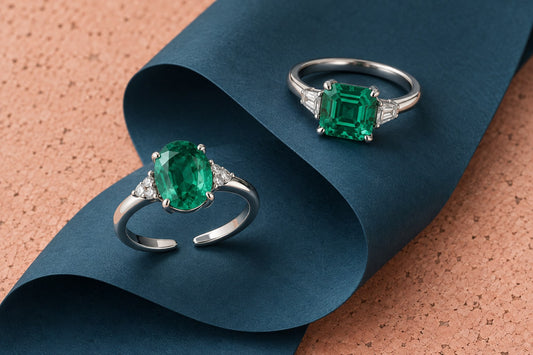
An emerald cut generally has a rectangular outline, clipped corners, and rows of elongated facets arranged like steps. Those broad facets create a different pattern of reflections from the smaller, more numerous-looking flashes associated with many brilliant cuts. The term describes workmanship and geometry. It doesn't promise a particular gemstone, quality grade, weight, or country of origin.
Emerald, without the word “cut,” identifies a green gemstone. GIA's emerald reference places it in the beryl mineral family. GIA's sapphire reference identifies sapphire as corundum. Cutting either material into a similar outline doesn't change that underlying identity. Think of “oval sapphire”: oval tells you the form, and sapphire tells you the gemstone. “Emerald-cut sapphire” follows the same logic, though the borrowed gemstone name makes it less obvious.
A green rectangular stone could be an emerald, but the photograph alone doesn't establish that. Conversely, an emerald doesn't have to be rectangular. It can be fashioned into an oval, pear, round, or another cut. The green material and the step-cut shape are independent choices, not a package deal.

Read a jewelry name in five separate parts
A useful product description should let you answer five different questions. You don't need to memorize every jewelry term. You need to know which question each word is answering, and notice when an answer is missing.
1. Which gemstone is being named?
Start with the material: emerald, sapphire, cubic zirconia, or another named stone. If a description only says “green gemstone” or “blue crystal,” don't silently upgrade it to emerald or sapphire. Color language may describe an appearance without identifying a mineral. A product can be attractive and still require a clearer material disclosure before it fits what you wanted to buy.
2. What does the cut tell you?
Look for words such as emerald cut, oval, pear, or Asscher cut. Shape and faceting style are closely related in everyday retail language, but an outline by itself doesn't reveal the whole facet arrangement. “Rectangular” is a useful visual description, not a complete substitute for a stated cut. If a particular step pattern matters to you, request a clear close-up of the selected stone.
3. Where did the gemstone grow?
“Lab-grown” and “lab-created” describe laboratory origin. They don't describe a cut, and they shouldn't be confused with a vague claim that a stone merely looks like another gem. Lumingem's explanation of lab-grown emerald origin and quality explores that separate question. Read the origin wording next to the actual gemstone name rather than assuming it applies to every stone in a mixed design.
4. What are the smaller stones?
A sapphire necklace can have sapphire main stones and cubic zirconia accents. An emerald ring can follow the same mixed-material approach. The center stone's name doesn't automatically identify its halo, shoulders, or other clear stones. Look for an explicit accent-stone description; “sparkling accents” alone is not the same as a diamond disclosure.
5. What is the setting made from?
Metal is another separate layer. In a description that says “K gold-plated 925 sterling silver,” sterling silver identifies the underlying metal and gold-plated describes the finish. It isn't a solid-gold description. Neither the metal wording nor the cut name establishes a plating thickness, exact gold fineness, or a promise about how long the finish will last.
Two real listings, decoded without guessing
The following examples show why reading the full name matters. They're not a price or quality contest: one is a necklace and one is a ring. They simply make the difference between a cut name and a gemstone name visible.
Emerald-cut lab-grown blue sapphire tennis necklace
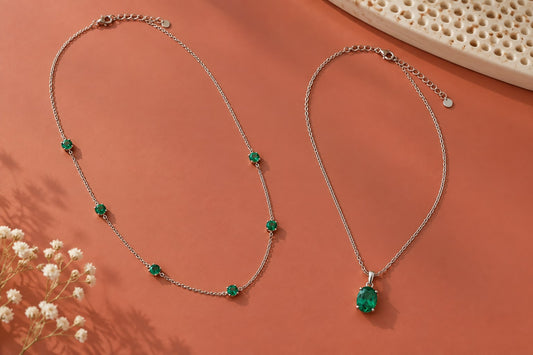
The blue sapphire tennis necklace is described with emerald-cut lab-grown blue sapphire main stones, cubic zirconia accents, a prong setting, and K gold-plated 925 sterling silver. Here, “emerald-cut” describes the main stones' cut. “Blue sapphire” identifies them. “Lab-grown” describes their origin, and “tennis necklace” names the jewelry format.
Nothing in that reading turns the blue stones into emeralds or the clear accents into diamonds. Nor does the word “tennis” supply an exact necklace length or clasp specification. Check those practical details separately before deciding how it will sit at your neckline. For the color question, the guide to blue sapphire color and origin is the more relevant next read.
Emerald-cut lab-grown emerald ring
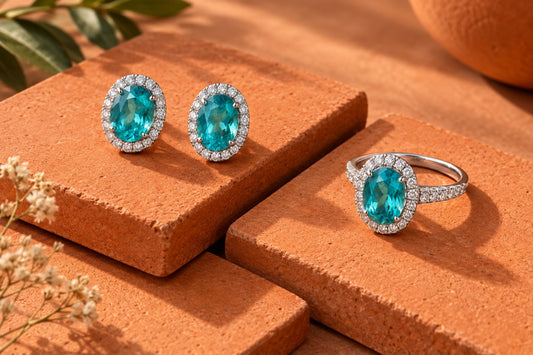
In the lab-grown emerald ring listing, the emerald-cut variant is described with a 6 × 8 mm center, cubic zirconia accents, an adjustable open band, and K gold-plated 925 sterling silver. The first “emerald” belongs to the cut name. The second names the green gemstone. Repetition here is useful: the two words carry different information.
The listing also offers other shapes, so check the selected variant instead of assuming every option has the same rectangular center. The stated millimeter dimensions describe the center's size, not its carat weight or the fit of the ring. “Adjustable” concerns the band; it doesn't change the stone's identity or mean unlimited adjustment.

Are emerald cut, Asscher cut, and rectangle interchangeable?
Not quite. Emerald and Asscher cuts are both associated with step-cut faceting, but the names shouldn't be used as though they mean any stone with straight sides. Emerald cuts are commonly rectangular; Asscher cuts are commonly square in outline with clipped corners. “Rectangle” tells you less, because it doesn't specify the facets.
You may encounter a broad-looking emerald cut or a listing that uses terms loosely. Rather than diagnosing the stone from a thumbnail, compare the stated cut, dimensions, and clear photographs of the exact option. The simple question “Is this the emerald-cut variant shown in the selected image?” can resolve a mismatch more usefully than arguing over a marketing label.
Keep “solitaire” separate, too. It refers to a design centered on one principal stone; it doesn't tell you whether that stone is emerald, sapphire, diamond, or something else. Likewise, halo describes surrounding stones, and prong-set describes how stones are held. These terms can narrow the look you want, but they don't replace a material description.
What photos and gemstone reports can actually tell you
A photograph can help you assess the outline, proportions, setting, and whether you like the overall design. It cannot by itself verify mineral identity or laboratory origin. Lighting, reflections, white balance, and your screen can all affect how a blue or green stone looks. A vivid green rectangle isn't proof of emerald, just as a blue step-cut stone isn't proof of sapphire.
If a seller provides a gemstone report, read what the report actually covers. Does it identify the center stone, a loose stone, or the finished item? Do its measurements and description match the product being offered? A document about one component should not be treated as verification of every accent stone and the metal setting.
Our guide to reading a gemstone certificate walks through those checks. Don't assume a report is included because an article mentions one. Ask the seller whether the exact item has a report, who issued it, and how to verify its number with the issuer.

Search for the material first, then refine the design
If you're looking for green emerald jewelry, start with “lab-grown emerald ring” or “lab-grown emerald necklace.” Add “emerald cut” only if you specifically want that cut. If you want a blue stone in a rectangular step-cut design, “emerald-cut lab-created blue sapphire necklace” is a more precise description of your intention.
The difference isn't about finding a magic search phrase. It's about avoiding the wrong category. “Emerald necklace” and “emerald-cut necklace” can describe quite different products. When you browse the Lumingem necklace collection, treat the collection as a starting point and open the individual listing for its stone and construction details.
For a gift, save the exact product link and selected option rather than forwarding only a screenshot or a short name. Add a plain-language note such as “blue sapphire, rectangular step cut” or “green lab-grown emerald, oval shape.” That small clarification can prevent someone from ordering the right outline in the wrong gemstone.
Frequently asked questions
Does emerald cut mean the stone is an emerald?
No. Emerald cut describes a cutting style, not gemstone identity. A sapphire or another material can have an emerald cut. Read the separate gemstone name and origin disclosure to understand what the stone is.
Can a blue sapphire have an emerald cut?
Yes. Blue sapphire can be fashioned in an emerald cut. It remains sapphire, a variety of corundum; the cut does not turn it into emerald or change its mineral family.
Does lab-created describe the cut or the gemstone?
Lab-created describes the gemstone's laboratory origin, not its cut. In an emerald-cut lab-created sapphire, emerald cut describes the cutting style and lab-created sapphire describes the material and origin.
Are clear accents on an emerald ring always diamonds?
No. Clear accents may be cubic zirconia, moissanite, diamond, or another disclosed material. Read the accent-stone specification separately from the center stone. If the listing doesn't identify the accents, ask rather than assuming.
Conclusion: separate the shape from the stone
The easiest way to read a jewelry name is to pause at each descriptive layer: gemstone, origin, cut, accents, and metal. An emerald-cut sapphire and an emerald-cut emerald can share a similar outline while remaining different gemstones. An oval emerald is still emerald, even without the rectangular shape people often associate with its name.
Before ordering, match the full description to the selected variant, confirm any missing dimensions or construction details, and keep the product link with your notes. You don't need an elaborate gemology vocabulary to shop thoughtfully. You need a clear answer to what each word means, and a willingness to ask when the listing leaves one out.
By Lumingem Editorial Team. Our jewelry guides explain published product specifications and practical shopping considerations. Product details checked September 15, 2026; this article does not report hands-on testing.
Tags:
Previous
Adjustable vs. Fixed-Size Lab-Grown Emerald Rings
Next
Padparadscha Jewelry With Eyeglasses: A Styling Guide
Related articles
How to Pack Hip-Hop Jewelry for a Weekend Away
Sep 14 2026