
Cubic Zirconia vs. Moissanite Accents in Paraiba-Color Jewelry
Cubic zirconia and moissanite accents can both frame a blue-green center stone beautifully. They are different materials, though, and the name of the accent tells you nothing about the identity of the center. A Paraiba-color ring with moissanite along the band is not necessarily a moissanite ring at its center. Likewise, a pair of earrings with cubic zirconia halos can have a completely different gemstone inside those halos.
That distinction matters when you're comparing jewelry online. Photos show the overall effect; the specifications should explain what each part is. Start with our guide to Paraiba jewelry labels if the center-stone terminology is unfamiliar. Here, the focus is narrower: how to read the clear accents, their placement, and their relationship to the piece you actually want to wear.
Key takeaways
- Read the center stone and accent stones as separate specifications.
- A halo surrounds the center; pavé describes closely set small stones, often along a band.
- Compare the whole design, including dimensions, setting, metal, and care requirements, rather than choosing by the accent name alone.
- If a listing leaves the center species unclear, ask for written clarification before buying.
Start by separating the center from its frame
A colored jewelry design usually has more than one material story. The blue-green stone may provide the color, while a halo or shoulder detail supplies a clear outline around it. Beneath both sits the metal setting, which may also have a plated finish. Combining those details into a single phrase can hide useful information.
For example, “Paraiba-color earrings with cubic zirconia” describes a color and an accent material. It does not, by itself, identify the blue-green center. “Moissanite pavé” identifies the small stones and their setting style, not the composition of the larger oval above them. Treat a product title as the introduction, then read the stone information as the specification.
A helpful shopping note has four separate lines: center material, accent material, metal, and finish. Copy the wording exactly. If one line is missing, leave it blank rather than filling it with an assumption from another item in the collection. Two pieces can share a color story without sharing a gemstone species.
What the accent description actually tells you

Cubic zirconia and moissanite are distinct gemstone materials, not different grades of the same stone. Neither name means diamond. Neither should be confused with the blue-green center merely because the whole piece appears under a colored-gemstone category.
For a broader introduction to clear stones, see our moissanite, diamond, CZ, and white sapphire comparison. When the stones are small accents, however, the immediate shopping question is often about the design: where are they placed, how much of the piece do they cover, and how do they outline the center?
Cubic zirconia in a halo
A halo puts the clear stones around the colored center. That border can make the entire setting look more expansive than the center's measurements suggest. A narrow, even border gives a different outline from a layered halo with pear-shaped accents or a scalloped edge.
Don't assume every cubic zirconia halo has the same scale or construction. Look for a straight-on image to understand the outline, then a side view to see the profile. Ask for the overall earring or setting dimensions if the listing supplies only the center-stone size.
Moissanite in a pavé band
Pavé uses closely set small stones to create a continuous-looking surface. On a ring, those stones may sit along the shoulders while the colored center remains visually separate above them. The layout can draw your eye across the band instead of building a border around the oval.
Check how far the accents extend and whether their position is visible from the side. A front-facing image alone may not show the complete band. The word “moissanite” doesn't answer those questions; the setting details and additional views do.
Read two real listings without mixing their materials
These two Lumingem pieces illustrate different accent arrangements. This is a comparison of their published specifications, not a hands-on wear test or a claim that one delivers a measured amount of extra sparkle.
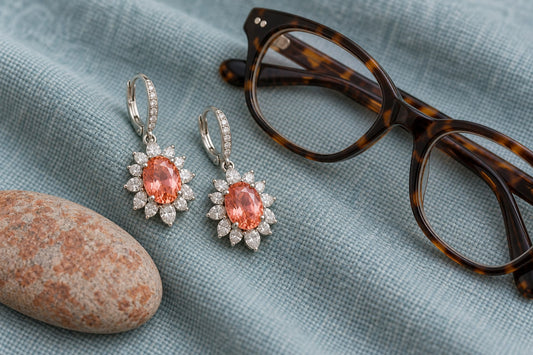
Paraiba-color YAG earrings with cubic zirconia halos
The oval Paraiba-color YAG halo studs identify the centers as synthetic yttrium aluminum garnet, or YAG, in a Paraiba-inspired blue-green color. Their clear accents are cubic zirconia. The listing describes layered halos and pear-shaped accents that create a scalloped edge.
The stated center dimensions are 6 × 8 mm, with 1.5 carats per center and 3 carats per pair. Those numbers describe the centers, not the complete outer silhouette of each earring. The metal is 925 sterling silver with a plated finish. The listing also notes that the Paraiba-inspired color may vary slightly between production batches.
The useful takeaway is not simply “these have CZ.” It is that the accent layout is part of their statement shape. If you're considering them for a gift, confirm the overall dimensions and fastening details as well as the blue-green color.
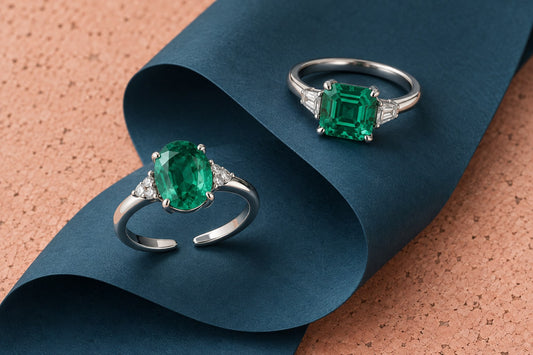
A Paraiba-color oval ring with moissanite pavé
The oval Paraiba-color ring with moissanite accents describes a 7 × 9 mm oval center in a four-prong setting, with moissanite pavé along the band. It lists 925 sterling silver and a K gold-plated finish.
The center is described as “lab-grown Paraiba,” but the published wording does not specify its underlying gemstone species. That is a detail to clarify before purchase. It would be incorrect to borrow the YAG identity from the earrings, or to assume this ring contains sapphire or tourmaline.
You can still understand the setting from the information provided: an oval focal point, four prongs, and a band accented with moissanite. Keep that design description separate from any unanswered question about the center. Clear disclosure is more useful than a reassuring guess.
Compare the silhouette before comparing sparkle

The amount and location of clear detail can change how jewelry fits an outfit. A full halo makes a defined shape around the color. A pavé band lets the colored stone sit apart from the accents. Neither arrangement is automatically more elegant; they emphasize different parts of the piece.
For earrings, picture the complete outline beside your face. Hair worn down may partly cover a small border, while an updo gives the entire halo room to show. For a ring, consider the top view and the side profile. If you plan to wear another ring beside it, ask how the settings sit together rather than judging the pairing from separate product photos.
Lighting also affects photographs. A close-up under bright spot lighting and a softer image near a window aren't controlled comparisons. Don't use the number of visible flashes in two different photos to identify the stones or rank their quality. Request comparable views when a visual detail matters to your decision.
A useful test is to describe the design without naming the accent material: scalloped halo studs, a slim pavé band, an oval center with an open outline. If that description matches what you like to wear, you have a sound starting point. Then confirm the materials and practical details.
Questions that make an online comparison more useful
Ask about missing specifications, not just whether a piece is “good quality.” A specific question is easier to answer and gives you information you can compare across designs.
- Which material is used in the center, and which in the accents? Ask for both names in writing if the title is abbreviated.
- Do the measurements describe the center or the complete setting? This is especially useful for wide halos and statement studs.
- Is the stated carat weight per stone or per pair? Don't compare a pair's combined weight with one ring center.
- What is the base metal, and what finish is applied? Silver content and surface plating are different details.
- What care instructions apply to the finished piece? The answer needs to account for its stones, settings, and finish together.
- Can the seller provide another view? A side image can answer questions about height and the position of the accents.
Keep the replies with your order information. They're helpful if you later need cleaning guidance or a jeweler asks what the piece contains. A screenshot of a clear specification is more useful than trying to remember a promotional phrase.
Care for the finished piece, not just one gemstone

Choosing moissanite accents does not make the center stone, plating, or setting maintenance-free. The same principle applies to cubic zirconia. Care has to suit the complete piece, including any material that isn't fully identified.
The linked earrings' care instructions advise avoiding perfume, household chemicals, and prolonged contact with water, then wiping with a soft, dry cloth and storing separately. The ring's instructions similarly recommend gentle wiping, separate dry storage, and avoiding harsh chemicals, swimming, and hard impacts. Follow the guidance for the exact item you own.
Don't assume an ultrasonic cleaner is appropriate because one component is familiar. If the center species, treatment, or setting condition is unknown, get specific advice before using cleaning equipment or solutions. A jeweler can also inspect an accent that looks loose; pressing it back yourself isn't a substitute for a secure setting.
Our Paraiba-color jewelry care guide explains how to approach a piece whose color name doesn't tell you everything about its materials. Keep its product-specific instructions alongside that general guidance.
Frequently asked questions
Does a Paraiba-color ring with moissanite accents have a moissanite center?
Not necessarily. Moissanite accents identify the small surrounding or band stones, not the center. Read the center-stone specification separately and ask for clarification if its material is not stated.
Are cubic zirconia halos made of natural zircon?
No. Cubic zirconia and natural zircon are different materials. A listing that specifies cubic zirconia should not be read as a natural zircon description.
Can I choose between CZ and moissanite accents from a photo?
A photo can help you compare placement and overall style, but it is not a reliable material identification. Use the written specifications to identify the accents and request clarification if the wording is incomplete.
Should I compare carat weight or dimensions?
Use both, but check what each number describes. Center dimensions help explain its face-up size; overall setting dimensions describe the complete outline. A weight stated for an earring pair should not be treated as the weight of one center stone.
Conclusion: choose a clear specification and a design you love
The most useful comparison isn't a blanket verdict that cubic zirconia or moissanite always wins. It's a clear account of where the accents sit, what the center contains, and how the finished jewelry fits your plans. A scalloped halo and a pavé band solve different design problems, even when both feature a bright blue-green focal point.
As you browse Lumingem at lumingem.com, keep the center, accents, metal, and finish separate in your notes. Choose the silhouette first, confirm the facts, and resolve anything missing before ordering. That approach leaves you with fewer assumptions and a much clearer idea of what you're buying.
By Lumingem Editorial Team. Our jewelry guides explain published product specifications and practical shopping considerations. Product details checked September 14, 2026; this article does not report hands-on testing.
Tags:
Previous
Lab-Grown Emerald Station Necklace vs. Pendant: Which to Choose?
Next
How to Pack Hip-Hop Jewelry for a Weekend Away
Related articles
How to Pack Hip-Hop Jewelry for a Weekend Away
Sep 14 2026