
Lab-Grown Emerald Earrings: A Practical Buying Guide
Choosing lab-grown emerald earrings is partly a gemstone decision and partly a design decision. The stone description tells you what you're buying. The outline, length, setting, and movement tell you how it will look when you wear it. Neither should be left to a single enlarged photograph.
GIA’s emerald reference distinguishes synthetic counterparts from imitations; its care guidance explains heat and ultrasonic-cleaning risks.
This guide compares the visual choices: studs versus drops, rounded versus angular shapes, quiet settings versus decorative outlines, and color in different outfits. For the practical details of posts, backs, and regular wear, use the separate everyday emerald stud guide. Keeping those decisions separate makes a shortlist easier to manage.
Confirm the material before comparing designs

Look for an explicit lab-grown emerald or lab-created emerald description. “Emerald green” can describe a color without identifying the gemstone. A green stone in an emerald-cut shape also isn't necessarily emerald; the cut name and the material name answer different questions.
Read the accents separately from the center stones. A halo is an arrangement of smaller stones around a center, not a promise about what those smaller stones are. Check their stated material, then check the metal and any surface finish. Save aesthetic comparisons for pairs whose descriptions you understand.
The lab-created emerald overview can help with the terminology. If the product page is unclear, ask for clarification rather than using color intensity or price to guess the stone's identity. Strong color is a visual impression, not a laboratory test.
Studs or drops: decide where you want the color
Studs concentrate color close to the ear
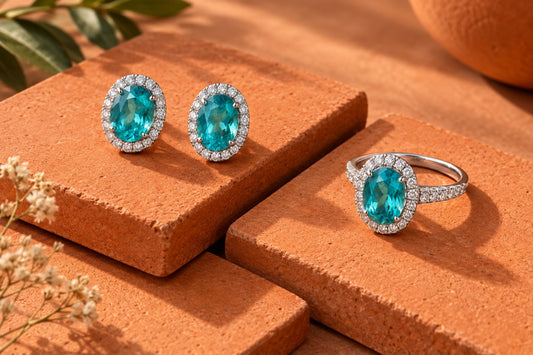
A stud keeps the composition compact. The visible shape sits near the piercing, making it a useful option when you want a clear green accent without an extended line. The setting can still be substantial: a halo or broad decorative border changes the footprint even when the center stone is small.
Compare the complete front measurements, not only the gemstone dimensions. For example, the oval lab-grown emerald stud listing is a place to examine one particular shape. Read its current specifications before deciding how the pair compares with earrings you own.
Drops place the emphasis lower and can add movement
A drop extends below the piercing. Some designs are rigid; others articulate at a link or hinge. Look at the construction rather than assuming every long earring swings. The difference affects how the shape appears as you turn your head and how it sits beside a collar.
Check total earring length and where that measurement begins. A pendant-shaped stone may be only one part of a longer design. If the image includes a model, use it for general context, then return to the measurements because ear placement and scale vary between people.
Hoop-based designs add another outline
A gemstone attached to a hoop combines the shape of the hoop with the shape of the drop. Evaluate both. A small hoop with a broad gemstone can create a different balance from a larger hoop with a tiny accent. Confirm the inner diameter, fastening, and overall length when those details are relevant.
Don't assume a specific silhouette is available because it appears in a styling image. Browse the current lab-grown emerald collection and use the individual product listings to confirm the available designs.
Compare the shapes without face-shape rules
There is no need to follow a rigid chart assigning one earring shape to one face shape. Start with the lines you enjoy in clothes and jewelry. The comparison is more useful when it reflects your taste than when it tries to correct your features.
Oval and rounded outlines
An oval introduces length while keeping a curved edge. A round outline is more compact. Compare width as well as height: a narrow oval can look quieter from the front than a wide one. The setting can amplify or soften those differences, especially when a border surrounds the center.
Rectangular and angular outlines
Rectangular shapes emphasize corners and straight lines. They can echo a structured collar, square neckline, or geometric ring. Check the orientation, because a vertical rectangle and a horizontal rectangle create different compositions even if the stone measurements are identical.
Pear and other tapered shapes
A tapered shape gives the eye a direction to follow. In a drop, its point and wider end become part of the overall line. Look closely at how the setting supports the outline and whether the orientation shown is the one you want.
Draw a few outlines to scale on paper and place them beside a familiar pair of earrings. This won't simulate gemstone sparkle, but it can prevent the common mistake of treating every close-up as if it showed the same size.
Separate gemstone size from setting size

The visible presence of an earring includes everything around the stone. A halo creates a broader outline. A simple setting leaves more attention on the center. Decorative metalwork can make a pair feel intricate without changing the center stone at all.
Compare like with like. If one listing gives only stone dimensions and another gives total earring dimensions, those numbers can't be placed in the same column without clarification. Ask for the missing measurement. Carat weight is useful context but doesn't tell you the full front width or drop length.
Projection matters visually too. A high basket can make a stud look more three-dimensional from the side. A flatter outline can read as more contained. Neither is inherently more elegant; decide which fits the way you like jewelry to sit.
Evaluate green in more than one photograph
Use several images to understand the range of appearances rather than selecting the brightest frame. A close-up under strong light can show facets and color differently from a wider view in softer light. Background color and screen settings can also change your impression.
Look for consistency between the two earrings when they are shown together under the same conditions. Don't compare one earring in a warm photograph with another in a cool photograph and conclude that they are mismatched. If matching is a concern, ask for a side-by-side image.
Decide what you want from the color. A deeper-looking green may suit a restrained palette; a brighter-looking green may be the focal point of the outfit. These are preferences, not universal quality rankings. The useful question is whether the actual pair matches the appearance you expect.
Build the outfit around one clear decision
With a patterned top, you might prefer a compact stud so the earrings don't compete with the fabric. With a plain neckline, a longer drop can become the main detail. Try the idea with your own clothes rather than buying for an outfit you don't own.
Hair and accessories affect visibility. Earrings partially covered by hair can read as flashes of color, while an updo exposes their full outline. Glasses introduce another shape near the face. Think about the combination without assuming every element has to match.
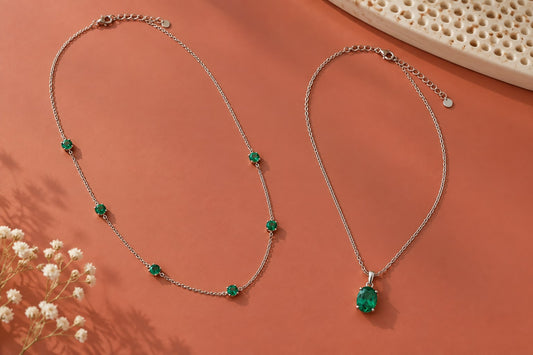
A matching necklace isn't required. You can repeat the metal color, use a smaller green detail elsewhere, or let the earrings stand alone. If you're choosing for a gift rather than yourself, the anniversary jewelry guide suggests ways to use the recipient's existing wardrobe as evidence.
A simple online comparison sheet

Once you have two or three candidates, stop opening new tabs and compare the same fields. Write “not stated” wherever information is missing. An empty field is a question to resolve, not a reason to assume the most favorable answer.
| Compare | What to record | Why it helps |
|---|---|---|
| Material | Center stone, accents, metal, finish | Prevents comparing unlike products as equivalents |
| Outline | Shape and complete front dimensions | Shows the visual footprint |
| Length | Total length and measurement method | Clarifies where a drop will sit |
| Construction | Setting profile and closure | Connects appearance with practical wear |
| Evidence | Front, side, back, and pair photographs | Reveals what one image leaves unanswered |
Then choose the compromise you're happy with. You may prefer a simpler setting because it keeps the color prominent, or a decorative border because you want a larger outline. A purchase is clearer when you can say why one pair suits the job better, not merely why it has more features.
After delivery: assess before altering
Compare the delivered earrings with the order and inspect them together in consistent light. Check the closures and visible setting without forcing or adjusting anything. Retain packaging and contact the seller about discrepancies before wearing or modifying the jewelry.
Follow the care guidance for the actual piece, including any finish or treatment precautions. Store earrings separately from other jewelry so loose pieces don't rub against one another. Avoid steam, ultrasonic cleaning, and abrasive products when their suitability hasn't been confirmed.
If the pair is intended for an event, leave time for this inspection. A delivery estimate isn't a guarantee, and discovering a fit question on the morning of the occasion leaves fewer options.
Frequently asked questions
Are studs or drops better for lab-grown emerald earrings?
Studs keep the color near the ear; drops create a longer line and can add movement. Choose according to the outline, outfit, and wear you want rather than treating one format as universally better.
Does an emerald cut mean the stone is emerald?
No. A cut name describes shape and facet arrangement, not necessarily gemstone identity. Read the material description separately and look for explicit lab-grown emerald wording.
Will two pairs with the same carat weight look equally large?
Not necessarily. Shape, proportions, and the surrounding setting affect visible size. Compare millimeter dimensions for the stones and the complete earrings, and confirm what the weight figure includes.
How can I compare gemstone color online?
Review several photographs and the written description, ideally including both earrings together. Lighting, backgrounds, and screens affect appearance. Ask for additional views if a particular shade is important to your decision.
Choose the design, then verify the details
A useful shortlist combines a clearly identified gemstone with an outline you can picture wearing. Compare the whole earring, not just its center stone, and settle missing measurements before buying. Explore Lumingem's stud earrings when a compact silhouette suits your plan, then let the exact product information guide the final choice.
Editorial responsibility: Lumingem Editorial Team. Product-specific questions: shopify@lumingem.com.
Tags:
Previous
Tennis Jewelry Gift Guide: Necklaces and Bracelets for Meaningful Milestones
Next
How to Choose a Lab-Grown Blue Sapphire Pendant Necklace
Related articles
How to Pack Hip-Hop Jewelry for a Weekend Away
Sep 14 2026