
Paraiba-Color Jewelry With Scarves: Keep the Color in View
When you wear jewelry with scarves, decide what stays uncovered first. A loosely draped scarf can frame a blue-green pendant; a scarf wrapped close to the neck usually leaves more room for a ring. Start with that choice instead of trying to make every accessory visible at once. Paraiba-color jewelry supplies the color, and the scarf determines where it has space.
This is a styling guide, not a gemstone identification guide. Paraiba-color describes a blue-green appearance here. One featured Lumingem ring is explicitly lab-grown YAG, not Paraiba tourmaline. The necklace uses a less specific gemstone designation, which we'll keep separate. For the distinction behind those names, see our guide to Paraiba gemstone labels.
The useful question in front of the mirror is simple: will your scarf frame the jewelry, cover it, or keep brushing against it? Each answer suggests a different outfit.
Look at the scarf's shape before its color
Bulk and placement matter before matching shades. A narrow silk scarf tied to one side behaves differently from a thick winter wrap, even when both are cream. Lay out the scarf with the top you'll actually wear, then tie or drape it before choosing the jewelry.
Find the area that remains visible without arranging the fabric by hand. Is there an open triangle over your blouse? A small gap above a crew neck? No exposed neckline at all? That naturally open area is more useful than a gap that disappears as soon as you turn your head.
Try the three-position check
Stand normally, sit down, and reach forward as though picking up your bag. Watch where the scarf ends settle. If they cross the proposed pendant position every time, choose another drape or move the jewelry to your hand. This isn't a test of how carefully you can hold an outfit in place.
Also notice the scarf's edges. Fringe, open knits, and loose decorative threads deserve extra clearance around settings. A smooth scarf can still catch; the goal is to avoid contact rather than assume a particular fabric is safe.
A loose drape can frame a blue-green pendant

For a pendant-led outfit, let the scarf fall down either side of the chest, with the gemstone resting in the clear space between. Keep the fabric ends outside the necklace rather than threading the chain through them. The pendant should be supported by its own chain, never by the scarf.
Picture a coffee date in an open wool coat: a plain blouse underneath, a lightweight scarf draped rather than knotted, and one compact pendant. The blue-green detail can sit against the blouse or inside its open collar. If the coat closes over everything outdoors, that's fine. The jewelry doesn't have to remain on display during the walk.
Use the actual length, not an imagined drop
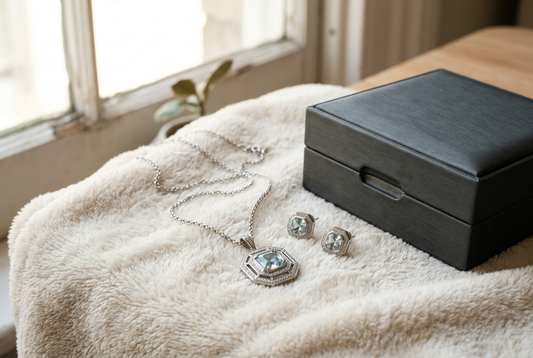
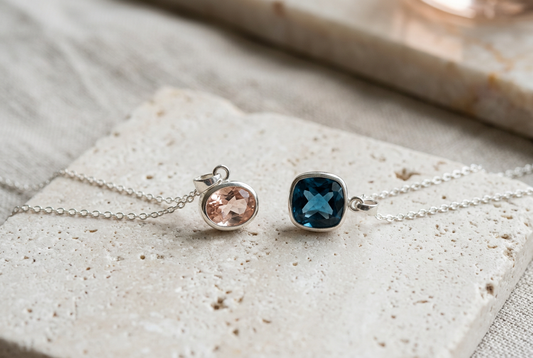
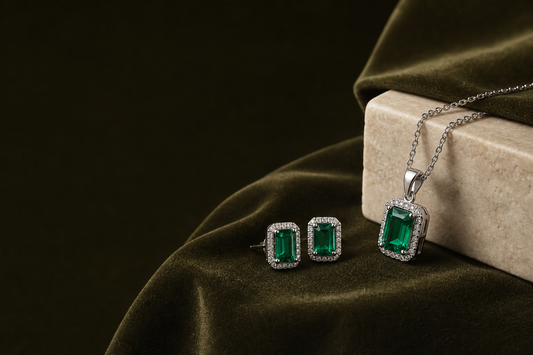
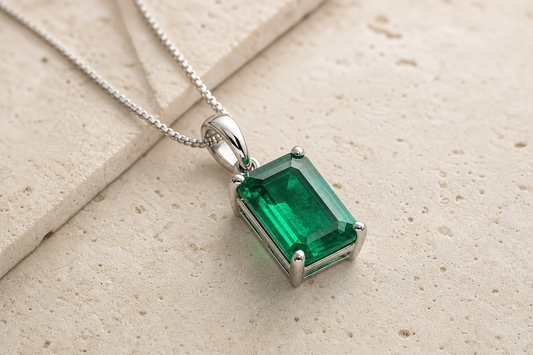
Lumingem's geometric Paraiba-color halo necklace has a listed necklace length of 41–50 cm, or approximately 16.1–19.7 inches, and a 7 × 9 mm emerald-cut center. Those measurements help you plan, but they don't guarantee where it lands on your body or over a sweater. A thick neckline takes up space, and a pendant's full setting extends beyond the center stone.
The current listing names the gemstone “Lab-Grown Paraiba” without identifying its mineral species. We aren't describing that center as tourmaline, sapphire, or YAG. Its documented design features are a blue-green emerald-cut center, a close halo, and gold-plated 925 sterling silver. Emerald-cut names the cut, not an emerald gemstone.
If its available length places the pendant directly on your neckline seam, don't plan on solving the problem with an unspecified extender. Check the actual closure and available options first, or choose a different top.
When the scarf wraps high, let a ring carry the color
A close wrap doesn't need a necklace underneath it for the outfit to feel finished. Let the scarf handle the neckline and use a blue-green ring somewhere the fabric won't cover. This is particularly useful with a high-collar coat or a scarf you intend to leave on indoors.
Consider a museum visit with a compact neck scarf and a plain long-sleeve top. A ring stays visible when you hold a program or rest your hand at your side; a hidden pendant adds little to that particular look. You can leave the wrist bare so the color doesn't have to compete with a crowded cuff.
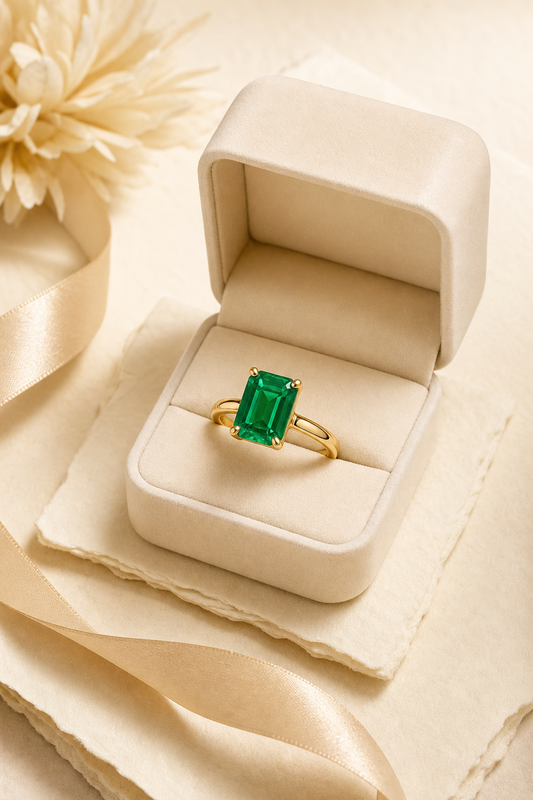
The oval Paraiba-color YAG floral ring offers a different outline from the geometric necklace. Its listing identifies a 1.5-carat, 6 × 8 mm lab-grown YAG center, pear-shaped zircon accents, and gold-plated 925 sterling silver. The accents form a petal-like border. YAG is the stated center material; this is not a Paraiba tourmaline ring.
The floral surround makes the whole ring broader than the center's dimensions suggest. Check the product photographs and your preferred ring size before deciding how it will sit beside a sleeve. The listed sizes are US 5–9; confirm your selected size's current availability.
If you wear gloves, remove the ring before pulling a tight glove over a raised setting. A ring is an alternative to neckline crowding, not a reason to ignore how the rest of the outfit moves.
Make one color connection with a printed scarf

You don't need an exact aqua match. A printed scarf can connect to Paraiba-color jewelry through a small blue-green detail, or it can provide a contrasting background. Decide which relationship you prefer before adding more accessories.
Pick up a minor color, not every color
With a cream scarf that has a few teal leaves or a narrow blue border, a ring can repeat that small detail. The scarf remains the larger pattern while the gemstone gives one color a second appearance. There's no need to repeat the shade in your bag and shoes, too.
Hold the scarf in its tied shape when judging the print. A large square can show several colors laid flat but reveal only one border when folded. Buy for the version you'll wear, not the full pattern spread across a table.
Use contrast when the print has no blue-green
A plain cinnamon scarf or a small burgundy print can sit beside blue-green jewelry without a matching detail. For a restrained combination, keep the top simple and choose either the ring or the pendant. These are styling suggestions, not fixed color rules; the shade you enjoy wearing matters more than following a palette formula.
A dense turquoise print may make a similarly colored pendant harder to distinguish. Rather than choosing an increasingly large stone to compete, separate them: use the scarf at the neck and the gemstone on your hand. For broader outfit ideas beyond scarves, our Paraiba-color ring styling guide covers other settings.
Plan for the moment you take your coat off
Choose whether the scarf belongs to the outfit or only to the weather. That decision saves you from building a necklace arrangement around a piece you remove at the door.
For a restaurant reservation on a cold evening, you might keep a pendant inside the coat and remove the winter scarf before sitting down. The necklace then works with the blouse underneath. You don't need a long chain draped outside the coat just to show the stone on the way there.
If a thin scarf stays on through lunch, arrange it as part of the indoor outfit instead. An off-center knot can leave room for a pendant, but only if the loose ends stay clear during normal movement. A centered knot sitting on top of a gemstone isn't a useful compromise.
Keep the changeover simple
At home, practice taking off your coat and scarf without pulling either across the setting. If the layers can't be removed freely, take off the necklace first and place it in a separate jewelry pouch. Don't leave a loose chain in a coat pocket with keys or tuck it into a folded scarf.
If you want multiple necklaces once the scarf is off, plan that combination separately. Our necklace layering guide explains spacing and movement. A scarf, two chains, and a pendant all meeting at the same point is a good reason to simplify.
Protect the fabric without modifying the jewelry

Clearance is the practical answer to scarf snags. Don't bend a prong, squeeze a bail, cover a setting with glue, or use a pendant as a makeshift scarf ring. Jewelry and scarf hardware have different jobs.
Before wearing the combination, look for a lifted thread in the scarf and an obviously uneven or loose component in the jewelry. If something catches, stop moving and support the fabric rather than pulling the two apart. Remove the piece if you can do so without force. A persistent catch or suspected loose setting calls for a jeweler's attention, not repeated at-home tugging.
Follow the individual product's care instructions after wear. The two pieces discussed here call for gentle wiping with a soft, dry cloth and separate storage, with avoidance of harsh chemicals and prolonged moisture. Keep fragrance away from the jewelry, including when spraying a scarf. The color description alone doesn't establish a cleaning method.
Buying a gift for someone who always wears scarves
Look at how the recipient wears scarves before choosing the jewelry type. Someone who favors loose, open drapes may enjoy a pendant. Someone who keeps a scarf closely wrapped all day may get more visible use from a ring, provided you know the correct size.
Think about fabric habits as well as taste. An ornate ring can be appealing to someone who likes floral prints, but it may be inconvenient if they often handle delicate shawls or wear close-fitting gloves. A photograph can help you discuss scale, while measurements and current listing details should guide the purchase.
When browsing Lumingem, compare the piece with one scarf and one neckline the recipient already owns. “This could work with your cream neck scarf” is a more personal starting point than picking a whole matching set. Confirm materials, size, availability, and current gift-return terms rather than assuming them.
Frequently asked questions
Can I wear a necklace and a scarf together?
Yes, if the scarf leaves stable space for the pendant and doesn't rub across the setting. A loose drape is easier to arrange around a necklace than a close wrap. Check the combination while sitting and moving.
Should a pendant go over or under a winter scarf?
It doesn't need to go over the scarf. You can wear the necklace with the top underneath and reveal it when you remove the scarf indoors. If the scarf stays on, a ring may be a simpler visible accent.
Does Paraiba-color jewelry have to match a teal scarf?
No. You can repeat a small blue-green detail in the print or use contrast. If the scarf and gemstone blend together, place the jewelry away from the neckline rather than trying to match them more closely.
Is the floral ring in this guide Paraiba tourmaline?
No. The featured floral ring is listed as lab-grown YAG with a Paraiba-inspired blue-green color and pear-shaped zircon accents. The color reference doesn't change its stated material.
Can I use a pendant to hold my scarf in place?
Don't use a pendant or its chain as a scarf fastener unless the maker specifically designed it for that purpose. Keep the scarf supported independently so its weight and movement don't pull on the jewelry.
Conclusion: leave the color somewhere to land
The easiest scarf-and-jewelry combination starts with the fabric, not a matching rule. Leave a clear opening for a blue-green pendant, or let a ring provide the accent when the neckline is covered. Judge the scarf folded, tied, and moving, then check what happens when you remove your coat. A successful outfit doesn't require constant adjustment. It gives the scarf its own shape and the jewelry enough room to be seen.
By Lumingem Editorial Team. Product details checked September 20, 2026. This guide draws on the linked Lumingem listings; it does not report independent product testing.
Tags:
Previous
Open-Back Padparadscha Sapphire Settings: What the Term Means
Next
How to Wear an Emerald Necklace With a Collared Shirt