
Adjustable vs. Fixed-Size Lab-Grown Emerald Rings
The ring looks right. The size menu is where the decision gets harder: one design says “Adjustable,” while another asks you to choose a US ring size. An adjustable lab-grown emerald ring can offer limited flexibility, but it isn't a substitute for knowing how a ring should fit. A fixed-size ring makes you choose a size upfront; it doesn't automatically promise a better fit or future resizing.
Start with the finger and the way you plan to wear the piece, then compare the construction. A slim open band for occasional wear presents a different decision from a ring you want to wear alongside a wedding band. This guide uses two current Lumingem listings to show what the descriptions actually establish, what they leave unanswered, and which questions are worth settling before checkout.
Adjustable and fixed-size rings: the practical difference
An adjustable ring has a construction intended to allow some change in fit. In an open-band design, that allowance comes from the band rather than a numbered size option. The amount of adjustment depends on the individual piece. “Adjustable” alone does not specify the smallest finger it fits, the largest finger it fits, or how often the fit can be changed.
A fixed-size ring is offered in defined sizes. You select the size that suits the intended finger instead of relying on an open-band allowance. This can make comparison more straightforward when you already know your size, but the number is only the starting point. A narrow band and a broad band can feel different, and the top of the ring affects how the whole piece sits.
| Decision | Adjustable ring | Fixed-size ring |
|---|---|---|
| Size selection | Confirm the intended adjustment range. | Choose an available numbered size. |
| Before ordering | Ask how the specific design should be fitted. | Check the size for the actual finger and band width. |
| Later changes | Do not assume repeated bending is appropriate. | Do not assume professional resizing is possible. |
| Gift uncertainty | Still requires enough information to assess fit. | Requires a reliable size or a plan to confirm it. |
Neither category wins every time. The better choice is the one whose sizing information matches what you know about the wearer. If the listing leaves the fit range unclear, that uncertainty belongs in the buying decision rather than being filled in with a hopeful guess.
What two emerald ring listings tell you

An oval emerald with an adjustable open band
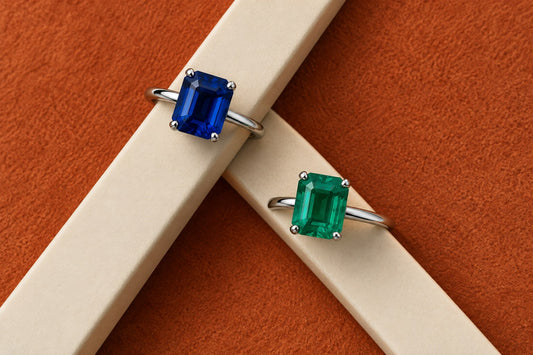
Lumingem's oval adjustable emerald ring lists an oval lab-grown emerald, an open band with small clear shoulder accents, and K gold-plated 925 sterling silver. Its size option is “Adjustable.” The product description says the construction offers limited flexibility, and its care guidance specifically warns against frequent or forceful bending.
Those details support a narrow conclusion: this is an open-band option with some fitting allowance. They do not establish a universal size range. They also don't tell you that the clear accents are diamonds or moissanite, so compare the ring using the stated facts rather than upgrading the materials in your imagination.
An Asscher-cut emerald offered in numbered sizes
The Asscher-cut lab-grown emerald ring lists a 1.5-carat center, K gold-plated 925 sterling silver, and US sizes 5 through 9. Its geometric center and three-stone design create a different outline from the oval open-band ring. The numbered options let you select a size rather than choosing a general adjustable option.
That is not a controlled comparison of otherwise identical rings. The center shape, surrounding design, and band are different too. Prefer the oval if its overall design appeals to you and the fit can be confirmed; prefer the Asscher style if you like the geometry and an available size suits you. Don't attribute every difference between them to adjustability.
Check the fit on the finger you intend to use
A ring that fits your right middle finger doesn't necessarily fit your left ring finger. Before shopping, decide where the emerald will live. If you already have a comfortable ring for that exact finger, use it as a reference and note whether its band is similar in width to the new design. A jeweler can help measure when your reference is uncertain.
Notice both the knuckle and the base of the finger
The ring has to pass over the knuckle and then sit comfortably at the base. If those two areas need very different amounts of room, guessing a size from a photograph is unlikely to resolve the problem. Ask for a fitting assessment rather than treating an adjustable band as a guaranteed answer.
During a careful try-on, notice whether the ring feels restrictive, shifts repeatedly, or needs constant attention to keep the center facing up. Some movement is ordinary; a ring that feels as though it could slip off needs a different decision. Don't tighten an open band aggressively to compensate for a heavy-looking top.
Think beyond a few seconds at a mirror
Consider simple movements you make while wearing jewelry: resting your hand on a desk, reaching into a pocket, or holding a small bag. The aim is to notice contact points, not to stress-test the ring. Remove it for exercise, cleaning, heavy lifting, or tasks that could strike or pull the setting.
Ring shopping becomes easier when you separate fit from appearance. If you love the green but dislike how the ring sits, look for another construction with a similar color instead of trying to make an unsuitable band work. Our guide to emerald ring shapes and settings can help you keep those choices separate.
Look at the underside, not just the emerald

A front view shows color and outline. A side or underside view shows where the band opens, how the shoulders meet the setting, and what may touch the finger. For an adjustable design, look for a clear view of the opening. For either style, check whether the product photographs and written description agree about the construction.
Do not mistake a decorative gap near the top for an adjustment mechanism. An open silhouette is a visual description; the listing should explicitly state whether the ring is adjustable. Likewise, a complete band in a photograph doesn't establish its resizing limits. If you need a specific alteration, ask before ordering.
Finish is another separate choice. Both examples above are described as K gold-plated 925 sterling silver, not solid gold. That wording identifies the silver base and a plated finish but does not specify a gold karat in the phrase “K gold.” For the wider material decision, read sterling silver versus gold emerald rings. A metal preference should not override an unresolved fit problem.
Buying a gift without knowing the ring size
An adjustable emerald ring can seem like the easy gift answer. It is only easy when the recipient's likely size falls within the ring's intended fit range. If the seller has not stated that range, “Adjustable” has not removed the uncertainty. It has changed the question you need to ask.
You can preserve much of the surprise while confirming which finger the recipient uses for a favorite ring. If possible, let them have that finger measured without tying the conversation to one specific design. Avoid borrowing a ring from a different finger and assuming the measurement transfers.
If the size cannot be confirmed, a pendant or earrings may be a more thoughtful choice than a ring that depends on luck. If a ring is the right gift, check the current return terms and any conditions concerning adjustments before purchase. Do not assume that a bent or altered piece will be treated the same as an untouched one.
A short gift note can focus on why you chose the emerald's color or the ring's shape. It doesn't need to promise a perfect fit. Making space for the recipient to choose a comfortable size is part of making the gift personal.
Will you wear it alone or beside another ring?

A ring worn alone has a different fit context from a ring worn beside a wedding band. Two pieces can crowd the same area, and a raised setting may meet the neighboring band in an awkward place. An adjustable gap does not automatically solve those problems, nor does a numbered size guarantee a comfortable stack.
Before building a pair, consider the combined width, the height of each setting, and whether edges or stones rub. Try the pieces together when possible. Don't close an adjustable band around a second ring or use it to hold another piece in place. Each ring should fit on its own.
For an engagement-ring pairing, our emerald ring and wedding band guide goes deeper into spacing and silhouette. Keep this comparison focused on the first decision: do you have enough information to choose the fit of the emerald ring itself?
When to stop adjusting and ask for help
An adjustable ring is not meant to be opened like a bracelet clasp each time you wear it. Follow the guidance for the exact design. For the oval example above, that means avoiding frequent or forceful bending. If you feel you must reshape it continually to keep it comfortable, pause and ask whether that piece is suitable for you.
Stop wearing a ring if a stone moves, a prong catches, the band appears distorted, or an edge feels newly rough. A qualified jeweler can assess the structure; a product photograph cannot. Don't use household tools, pull on the gemstone, or assume an unfamiliar ring can be resized because another one was.
The same restraint applies to fixed-size rings. Choosing a size is not a promise that it can be changed later. Get a specific assessment before treating resizing as part of your purchase plan.
Frequently asked questions
Does an adjustable emerald ring fit every finger?
No. Adjustable describes a limited fitting allowance, not a universal size. Ask for the intended fit range and adjustment guidance for the specific ring. If those details are missing, don't assume it will fit.
Is a fixed-size ring automatically resizable?
No. A numbered size tells you how the ring is sold, not whether a jeweler can alter it. The band, setting, accent stones, and finish all need assessment before resizing is promised.
Can I adjust an open ring every time I put it on?
Don't treat the opening as a clasp. Lumingem's oval adjustable emerald ring listing warns against frequent or forceful bending. Follow the instructions for your specific piece and ask for help if the fit isn't comfortable.
Which ring is better when buying a gift without a ring size?
An adjustable ring is an option only when its intended fit range suits the recipient. If you cannot verify that, confirm the size first or choose jewelry that does not require a finger measurement. Review the current return terms before ordering.
Does lab-grown emerald mean the ring will be comfortable?
No. Lab-grown describes the gemstone's origin, not the fit of the band. Comfort depends on the correct size, band shape, setting proportions, and the individual wearer.
Conclusion: choose a fit you can verify
Choose an adjustable lab-grown emerald ring when you like the open-band design, understand its fitting limits, and can follow the adjustment guidance. Choose a fixed-size ring when you have a reliable measurement and an available size suits the finger and band style. Neither choice should depend on forcing the fit after delivery.
Once those questions are answered, the enjoyable part becomes simpler: oval or Asscher, understated shoulders or a broader silhouette, a ring for solo wear or a planned pair. Browse the Lumingem ring collection with the sizing information beside the photographs. The right ring should make sense on your hand, not just on your screen.
By Lumingem Editorial Team. Our jewelry guides explain published product specifications and practical shopping considerations. Product details checked September 15, 2026; this article does not report hands-on testing.
Tags:
Previous
How to Pack Hip-Hop Jewelry for a Weekend Away
Next
Emerald Cut vs. Emerald Gemstone: Read Jewelry Names Clearly
Related articles
How to Pack Hip-Hop Jewelry for a Weekend Away
Sep 14 2026